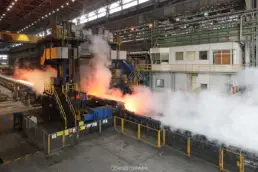
Konin Lignite Mine (PAK KWB Konin S.A.) is an open-pit brown coal mine in eastern Greater Poland, based in Kleczew. Since 1945 its pits around Konin have produced, according to the mine, over 645 million tonnes of lignite for the Konin and Pątnów power stations. It belongs to the ZE PAK group. Its last pit, Tomisławice, ends mining in 2026, closing more than 80 years of lignite mining in the Konin region.
| Full name | PAK Kopalnia Węgla Brunatnego Konin S.A. |
|---|---|
| Seat | Kleczew, Konin County, Greater Poland |
| Mineral | lignite (brown coal), open-pit mining |
| Mining since | 1945 (Morzysław pit, built from 1941) |
| Named KWB „Konin” | July 1955 |
| Group | ZE PAK (since 18 July 2012) |
| Customers | Konin power station (from 1958), Pątnów (from 1967) |
| Total output | over 645 million tonnes of coal; over 2.8 billion m³ of overburden removed (mine data) |
| Last pit | Tomisławice (2011–2026) |
| Coal transport | mine railway (PAK Górnictwo); from Tomisławice by truck, then rail |
Key facts
- KWB Konin is one of Poland’s lignite mines, alongside Bełchatów and Turów, and for decades fuelled large power stations.
- Coal came from a series of open pits, from Morzysław on the edge of Konin to Tomisławice on the border of Greater Poland and Kuyavia.
- Mine, mine railway and power stations formed one system: excavator, conveyor, wagon, trestle, boiler.
- In 2012 the mine joined the ZE PAK group, which is phasing out coal and building renewable energy.
- Mining ends in 2026. The pits are becoming lakes, forests and leisure areas.
History of the Konin mine
1940s: Morzysław and the briquetting plant
The lignite seam at Morzysław was exposed in 1934. The German occupiers began building the mine, a briquetting plant and a small power station in 1941–1942. After the war, in 1945, a Polish workforce took over, and from 1946 coal also went to the briquetting plant. The briquettes were pressed from coal alone, without binder. After a coal-dust explosion in 1960 the plant was rebuilt and modernised. Closure was decided in 1986, but the last batch of briquettes came off the line only on 14 April 2002.
1950s and 1960s: coal for power
The Niesłusz pit opened in 1953, and in July 1955 the works became Kopalnia Węgla Brunatnego „Konin”. Real growth came with power generation: Konin power station started in 1958 and Pątnów from 1967. New pits followed: Gosławice (1958), Pątnów (1962) and Kazimierz South (1965). The mine built its own railway to haul coal, worked from 1958 by EL2 electric locomotives.
1970–2011: new pits to the north
As the deposits near Konin ran out, mining moved north towards Kleczew and Ślesin: Jóźwin (1971), Lubstów (1982), Kazimierz North (1995), Jóźwin IIB (2003), Drzewce (2005) and Tomisławice (2011). The most productive was the Pątnów pit, with almost 130 million tonnes.
Since 2012: ZE PAK and the wind-down
On 18 July 2012 ZE PAK took over the mine, which has since operated as PAK Kopalnia Węgla Brunatnego Konin S.A. As the Pątnów I units were shut down, pits closed: Drzewce in 2022, Jóźwin IIB in 2023. Coal from Tomisławice now feeds only unit 9 at Pątnów. Mining, once planned to end in 2024, was extended to the end of 2026.
Open pits of KWB Konin
The Konin mine was never a single pit. The coal lay in several smaller deposits, so mining moved from place to place. Below are opening years according to Wikipedia and, where known, closing years.
| Pit | Opened, notes |
|---|---|
| Morzysław | 1941 (construction), mining from 1945 |
| Niesłusz | 1953 |
| Gosławice | 1958 |
| Pątnów | 1962; almost 130 Mt |
| Kazimierz Południe | 1965 |
| Jóźwin | 1971 |
| Lubstów | 1982 |
| Kazimierz Północ | 1995 |
| Jóźwin IIB | 2003; closed 2023 |
| Drzewce | 2005; closed 2022 |
| Tomisławice | 2011; closed 2026 |
How an open-pit mine works
First the overburden of sand, clay and gravel above the coal seam must be removed. This is done by huge bucket-wheel and bucket-chain excavators. Material travels on belt conveyors, and spreaders dump the overburden back into the mined-out part of the pit. On our visits we learned that a single conveyor section drive has a 320 kW motor, sometimes 640 kW, and some sections have more than one motor.
The chain of a bucket-chain excavator constantly scrapes the ground and wears down. In the Kleczew workshops industrial robots hard-face the links, and the forge makes new excavator teeth. Parts of excavators, conveyors and rolling stock are overhauled here. The mechanical and electrical workshops serve all group companies and, when there is spare capacity, outside customers too.
The SRs 1800 excavator „Dolores”
The mine’s best-known machine today is the SRs 1800 bucket-wheel excavator called „Dolores”. It was built by VEB Schwermaschinenbaukombinat TAKRAF in Leipzig. The mine bought it from Spain, where it had worked before, which is how the management of the day came up with the name. It weighs about 2,690 tonnes and spent several months cutting the exit ramp out of the Jóźwin pit. It was one of two „Spanish Sisters” in that pit. It stays energised and is guarded around the clock.
Getting the coal to the power stations
Coal from Konin went to the power stations by train, not by conveyor. At its peak the mine railway had about 120 km of track, 15 stations and 225 sets of points. Coal ran from the excavator by conveyor straight into wagons, and EL2-hauled trains took it to the unloading trestles at Pątnów and Konin.
The Tomisławice pit has no rail link. Coal is loaded from the conveyor onto truck trailers and driven to a transfer point, then goes on by rail to Pątnów. At the Kleczew transfer yard an ŁZKS-500 rail-mounted loader-spreader-excavator, built by FUGO Konin, stacks coal from wagons onto a stockpile or reloads it into wagons.
The ZE PAK group: mine, railway, power stations
The mine was the first link in a chain that ended in the boilers. In the ZE PAK group each link is run by a separate company:
| Company | Role in the ZE PAK group | Lexicon entry |
|---|---|---|
| PAK KWB Konin S.A. | lignite mining (pits, excavators, conveyors, Kleczew workshops) | this entry |
| PAK Górnictwo sp. z o.o. | mine railway: coal haulage, EL2 locomotives, Kazimierz Biskupi depot | PAK Górnictwo |
| ZE PAK S.A. | Pątnów, Konin and Adamów power stations; parent company | ZE PAK |
End of mining and land restoration
Former pits near Konin are turning into lakes and forests. Water already fills the old Lubstów pit. Once Tomisławice stops in 2026, the Konin region will no longer be a coal basin, and the ZE PAK group is moving to solar, wind and hydrogen. KWB Bełchatów faces a similar path.
KWB Konin and Zrobotyzowani
The Konin mine is the place we return to most often. Every visit was possible thanks to the management of PAK KWB Konin S.A. and PAK Górnictwo, with mine staff as guides, including Chief Mining Engineer Marcin Kaźmierczak.
| Date | Event | Report |
|---|---|---|
| September 2022 | first visit: Tomisławice pit, coal transfer | report (PL) |
| April 2023 | two days: workshops, Tomisławice, railway depot | report (PL) |
| 24 May 2024 | excavators and conveyors: ŁZKS-500, „Dolores” | report (PL) |
| 25 May 2024 | „Crocodiles Golden Hour”: two special coal trains | report |
| 4 October 2024 | Kleczew workshops, Tomisławice, „Dolores” after dark | report (PL) |
| 28 March 2025 | mechanical and electrical workshops | report |
| 18 April 2026 | „Last Crocodiles”: farewell to the EL2 | report |
Getting there and visiting
The mine’s head office is in Kleczew, some 15–20 km north of Konin. Pits, spoil heaps and post-mining lakes are easy to see from public roads between Konin, Kleczew and Ślesin. Access to the working mine, workshops or pit edge is only possible on organised visits approved by the company.
Frequently asked questions
Where is KWB Konin?
The mine is in eastern Greater Poland, north of Konin. The company seat and workshops are in Kleczew; the pits stretched from Konin itself to the area around Kleczew, Kazimierz Biskupi, Ślesin and Wierzbinek.
When does mining end at KWB Konin?
The last working pit, Tomisławice, is due to stop mining at the end of 2026. Drzewce closed in 2022 and Jóźwin IIB in 2023.
How much coal did the Konin mine produce?
According to the mine, over 645 million tonnes of lignite were produced in more than 80 years, requiring the removal of over 2.8 billion m³ of overburden. The largest, Pątnów, yielded almost 130 million tonnes.
Who owns KWB Konin?
Since 18 July 2012 the mine has belonged to the ZE PAK group as PAK Kopalnia Węgla Brunatnego Konin S.A. Its coal went to the group’s Konin and Pątnów power stations.
How did the coal reach the power stations?
For decades the mine’s own industrial railway carried it, worked by EL2 electric locomotives nicknamed Crocodiles. The Tomisławice pit has no rail siding, so its coal is trucked to a transfer point and then taken by rail to Pątnów power station.
Can you visit the Konin lignite mine?
It is a working industrial site, so it cannot be visited on your own. Access is only possible on organised visits approved by the company, such as Zrobotyzowani technical trips.
What is the excavator „Dolores”?
An SRs 1800 bucket-wheel excavator built by TAKRAF of Leipzig. The mine bought it from Spain, hence the name. It weighs about 2,690 tonnes and spent several months cutting the exit ramp out of the Jóźwin pit.
Sources
- Wikipedia: Kopalnia Węgla Brunatnego Konin (tabela odkrywek i daty), Zespół Elektrowni Pątnów-Adamów-Konin, Koparka wielonaczyniowa
- Energetyka24: W 2026 r. ZE PAK zakończy wydobycie w Tomisławicach; WNP.pl: Kopalnia Konin skończy pracę później, niż zapowiadano (4.12.2024)
- Broszura pamiątkowa „Ostatnie Krokodyle” (KWB Konin, 18.04.2026): historia kopalni, brykietowni i dane o wydobyciu
- Informacje przekazane podczas wizyt Zrobotyzowanych przez Naczelnego Inżyniera Górniczego PAK KWB Konin S.A. i pracowników warsztatów w Kleczewie (2022–2025)
- Relacje Zrobotyzowanych: wrzesień 2022, kwiecień 2023, maj 2024, październik 2024, marzec 2025