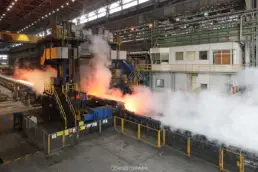
The PRESA glassworks in Pobiedziska near Poznań makes glass packaging: jars and bottles for the food and drinks industries. The plant traces its roots to 1952 and, according to the company, can produce about 120 million containers a year.
| Name | PRESA sp. z o.o. |
|---|---|
| Address | ul. Fabryczna 4, Pobiedziska, Greater Poland |
| Origins | 1952, „Hutnik” glass workers’ cooperative (according to the plant) |
| Capital | 100% Polish (according to the plant) |
| Products | clear glass jars and bottles |
| Capacity | about 120 million containers a year |
| Furnace | natural-gas-fired glass tank, about 100 tonnes of glass a day |
| Melting temperature | up to about 1,550°C |
Key facts
- The Presa glassworks in Pobiedziska makes clear-glass jars and bottles; according to the company, its roots go back to 1952.
- According to the company, the plant can make about 120 million containers a year.
- Its gas-fired tank furnace melts about 100 tonnes of glass a day at up to about 1550°C.
- During our visit, cullet made up more than 60% of the batch.
History
According to the plant, its story began in 1952, when the „Hutnik” glass workers’ cooperative was set up in Pobiedziska. Today it belongs to PRESA, a Polish-owned company. The works stand by the former national road 5 and look modest from outside: a few halls and a small brick chimney. Greater Poland, with its strong farming and food processing, is a natural home for a jar and bottle maker.
How a jar is made
It all starts with designing the shape for a customer. In the batch house raw materials are mixed: glass sand, soda ash, limestone, mineral additives and cullet (recycled glass). During our visit cullet made up more than 60% of the batch, saving raw materials and energy.
The batch goes into the glass tank, a ceramic furnace filled with molten glass and heated by gas burners to about 1,550°C. Every 25 minutes the firing reverses: one pair of burners goes out and the other lights, so that heat stored in the regenerators warms the combustion air. From the tank, glass flows to feeders that cut it into gobs. The gobs slide into the moulds of forming machines, where compressed air blows them into jars or bottles. Still glowing, the containers cool slowly in the annealing lehr and then pass automatic and visual quality checks.
Pobiedziska and Zrobotyzowani
On 13 April 2024 we toured the glassworks with a group of participants. It was our second event of 2024 and also supported the Great Orchestra of Christmas Charity. We saw the furnace control room, the batch house, the glass tank and the forming machines at work.
See also in the Lexicon
Visiting
Pobiedziska is about 25 km north-east of Poznań, on the railway to Gniezno. The glassworks is a working plant and does not offer regular tours.
Frequently asked questions
What does the Pobiedziska glassworks make?
Glass containers: jars and bottles for the food and beverage industries.
How is a glass jar made?
Sand, soda, limestone and cullet melt in a tank furnace at about 1550°C; gobs of glass drop into the moulds of forming machines, where compressed air shapes them, and the products then cool in an annealing lehr.
Can I visit the Presa glassworks?
It is a working plant without regular tours; visits are possible for organised groups.
Sources
- Relacja Zrobotyzowanych: Zrobotyzowani w szklanym świecie (informacje przekazane przez hutę podczas wizyty 13 kwietnia 2024)
- Profil pracodawcy PRESA sp. z o.o.: pracodawcy.pracuj.pl