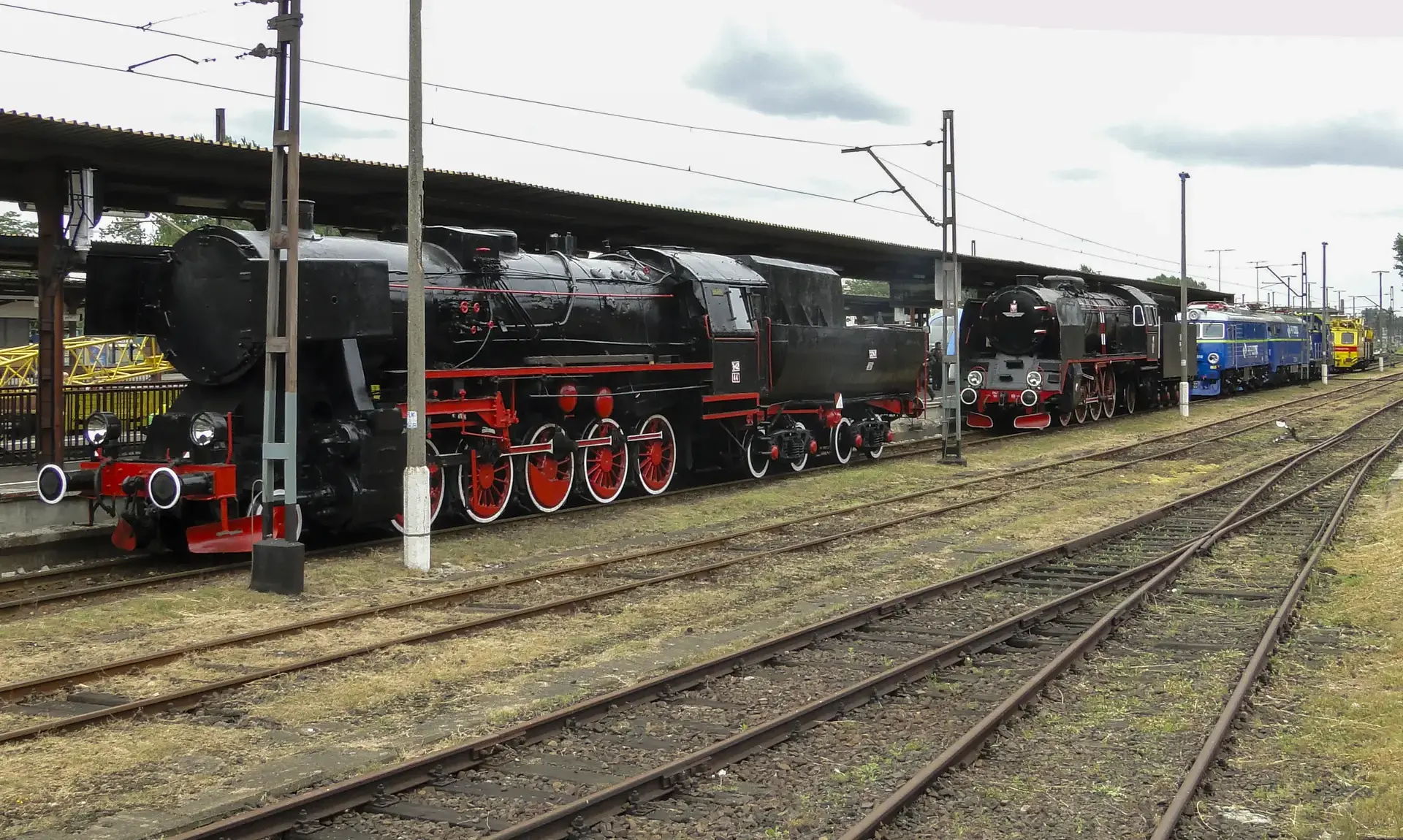
TOZKiOS, the Society for the Protection of Railway Heritage and Open-Air Museums (Towarzystwo Ochrony Zabytków Kolejnictwa i Organizacji Skansenów), is a railway enthusiasts’ association from Pyskowice in Upper Silesia, active since 1998. In the former roundhouse by Pyskowice station it has gathered more than 60 historic rail vehicles: some 27 steam locomotives, about twenty diesels, passenger and freight wagons and even a pre-war electric multiple unit. It also owns something few volunteer groups in Poland can claim: its own working freight steam locomotive, Ty42-24, which hauls heritage trains across the country.
| Full name | Towarzystwo Ochrony Zabytków Kolejnictwa i Organizacji Skansenów Pyskowice |
|---|---|
| Abbreviation | TOZKiOS (also TOZK) |
| Legal form | association, public benefit organisation |
| Founded | 1998; court register KRS 0000031208 (entered 21 September 2001) |
| Seat | Pyskowice, Gliwice County, Silesian Voivodeship |
| Museum | former Pyskowice locomotive depot: roundhouse, water tower, carriage shed |
| Collection | 60+ vehicles: c. 27 steam, 19 diesel, c. 15 passenger and 20+ freight wagons |
| Working steam locomotive | Ty42-24 (Fablok 1945), operational since 2013 |
| Oldest exhibits | wagons of 1909–1915, diesel Kö 0130 of 1934 |
Key facts
- The Society was founded in 1998; its museum is in a roundhouse that has stood by Pyskowice station since 1902.
- The collection has more than 60 vehicles, including about 27 steam and 19 diesel locomotives.
- Ty42-24 (Fablok 1945) returned to service in 2013 after more than four years of overhaul and hauls heritage trains all over Poland.
- The collection includes eight TKp “Śląsk”-type tank engines and diesel Kö 0130 of 1934.
- Pyskowice was known for its sand railway, where steam lasted until 15 April 1993.
Railway history of Pyskowice
A junction and a sand railway
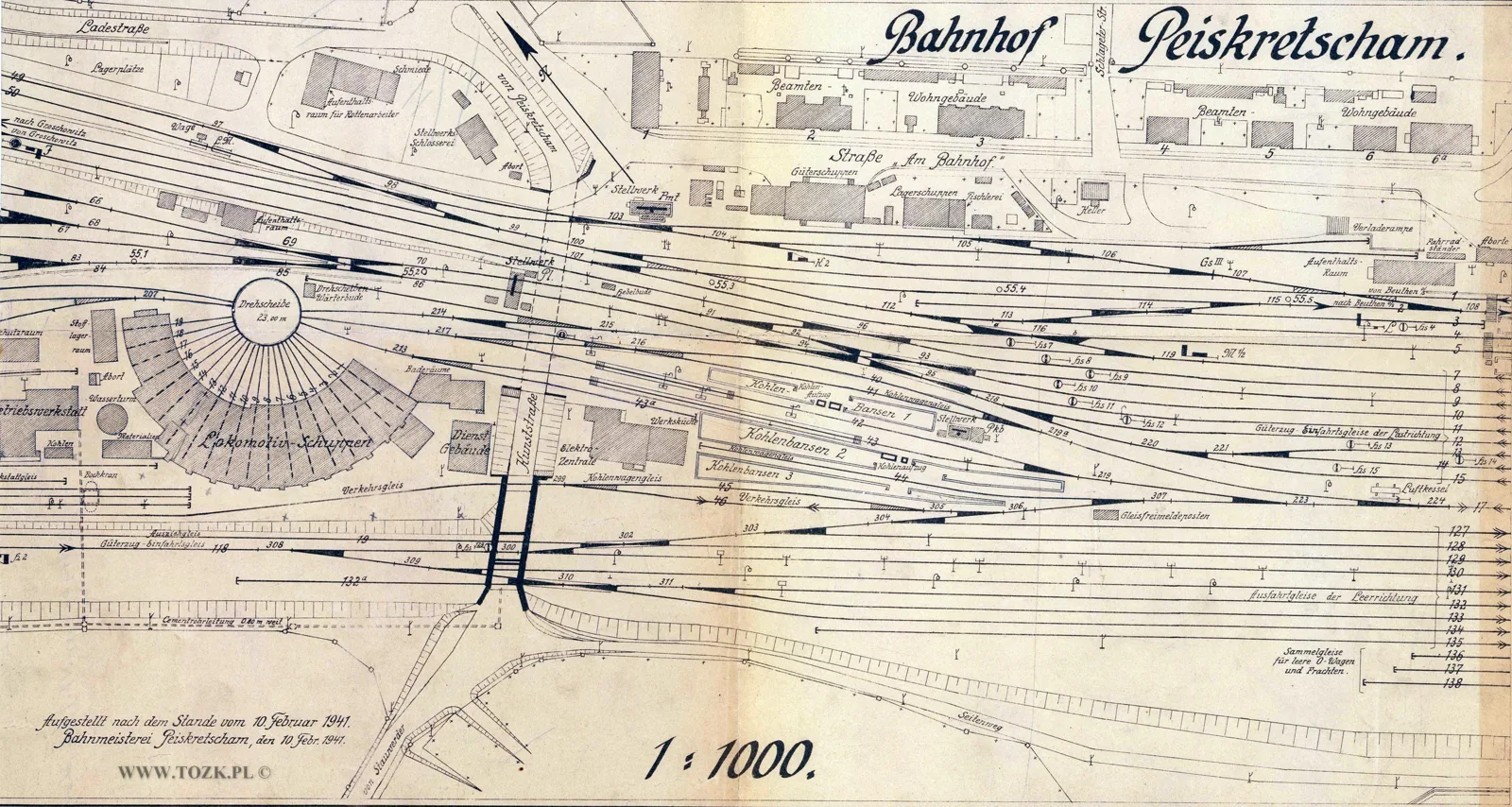
The first train reached Pyskowice (German: Peiskretscham) on 15 August 1879, when the line from Wrocław via Opole and Toszek was extended towards Bytom. By 1880 branches to Gliwice Łabędy and Zabrze Biskupice followed, turning the small town into a junction. From 1902 a large fan-shaped roundhouse operated here – the building that houses the museum today.
Pyskowice’s other railway identity is the sand railway. A company founded in 1909 built a line carrying backfill sand to Silesian coal mines. Heavy trains of three-axle wagons were hauled by Borsig 2-10-0 tank engines, and in 1935 they were joined by the famous TKz class: 139-tonne machines considered the heaviest tank locomotives in Europe at the time. Their weak point was a very efficient boiler combined with small fuel bunkers. One survives, TKz 211, at the railway museum in Warsaw.
War and an unfinished marshalling yard
During the Second World War Upper Silesia became an industrial base of the Third Reich and traffic soared. The Germans began rebuilding Pyskowice as a large marshalling yard: they lengthened the roundhouse stalls and planned new track groups and a second depot. The work was never finished, and traces are still visible: concrete structures by the Drama river, bridge abutments on Mickiewicza Street and the walls and inspection pits of an unfinished shed. Right after the war a 1524 mm broad-gauge track also ran through Pyskowice, laid for the Red Army and for shipping goods from Silesia eastwards.
The post-war heyday
On 17 May 1953 a line from Lubliniec opened, relieving the Tarnowskie Góry junction. On 3 October 1960 the inaugural EMU ED70-01 ran through Pyskowice on the newly electrified Gliwice – Opole – Wrocław main line. In December 1964, on miners’ day (Barbórka), a five-kilometre branch to Pyskowice Miasto opened to serve a new housing estate. On the sand railway, steam gradually gave way to TEM2 and M62 diesels and 3E electrics.
Even so, steam lasted unusually long in Pyskowice. In the late 1970s three American-built Ty246 locomotives from post-war UNRRA aid (nos. 24, 38 and 58) were based here; the tenders of two of them now belong to the Society and are among the last remains of the class in Poland. In 1983 the sand railway said goodbye to its last Tp4 engines. At a time when photographing railways was banned, the depot was one of the few places open to organised groups of foreign enthusiasts, which is why many colour photos from those years survive.
The sand railway’s last steam locomotive, Ty51-140, left Pyskowice in steam on 15 April 1993. The 1990s brought the junction’s decline: in 1999 the double-track line to Zabrze Mikulczyce closed to freight, on 2 April 2000 the last passenger train left Pyskowice Miasto, and in 2004 that branch was dismantled. Platforms and a tunnel for the Regional Railway (KRR), under construction since the 1980s to link Pyskowice with Katowice and Dąbrowa Górnicza, were never finished either. Of a track layout about 5 km long, only the running lines and the section leased by the Society remain.
History of the Society
Beginnings: Ol49-12 and 1998
It started in 1993, when a group of enthusiasts rented the locomotive shed at Pyskowice Kotlarnia and brought in steam locomotive Ol49-12. Led by Jerzy Wicher and helped by former staff of the Przezchlebie steam locomotive works, they returned it to service. According to the Society, Ol49-12 then ran for ten years, until June 2007, as a working exhibit at the Maldegem steam centre in Belgium. The idea of an association was born at the same time and it was formally established in 1998. The first steam locomotive in the collection was TKp 3409 from the Łabędy steelworks, acquired in 1997.
TKp 4422 and the first exhibitions
For years the Society’s showpiece was TKp 4422 “Śląsk”, according to TOZKiOS the only working engine of the type in Poland. Its boiler was overhauled around 2003 together with the Pyskowice firm PPHU “Januszewski Wicher”. The locomotive hauled the first freight train at the opening of the Gliwice Port terminal, appeared at celebrations at the Julian coal mine in Piekary Śląskie and starred in “Operation Foxley”, an episode of Bogusław Wołoszański’s TV series “Sensacje XX wieku”. In 2004–2005 the Society held rolling-stock exhibitions on its site.
Members also helped overhaul steam locomotive TKh 05353 at the Pyskowice works, gaining qualifications in railway trades that are now rare. That engine now runs as a working exhibit of the Wrocław Railway Enthusiasts’ Club.
2011: Ty42-44 and Pt47-50
On 11 April 2011 PKP Cargo handed over steam locomotive Ty42-44, which had stood as a monument at the Katowice locomotive depot since 2000. In April–June volunteers restored it in the Katowice roundhouse and finished just before the Railway Technology Days. On 18 June 2011 Ty42-44 and express locomotive Pt47-50, nicknamed Petucha, were on display in Gliwice. The next day both returned to Pyskowice.
Recent years
The Society campaigned against the demolition of the Pk5 gantry signal box in Pyskowice. After it was dismantled in May 2023, its steel frame was moved to the museum site, and in January 2024 Gliwice County took it over free of charge. In July 2024 Opole University of Technology became the Society’s patron, and in September 2024 diesel LDH45-24 and wagons 206S and 220S joined the collection. In 2013 the Board of the Silesian Voivodeship honoured the Society’s work.
Ty42-24, the mascot locomotive
Ty42-24 was built in 1945 by Fablok in Chrzanów (works no. 1529), with a boiler made in 1943 by ZNTK Wrocław. It spent its career mainly in Silesia, at the depots of Sędziszów, Pyskowice, Katowice, Chebzie, Szopienice, Łazy, Bielsko, Czechowice-Dziedzice and Szczakowa. Its last years were spent at Łazy as a stationary heating boiler. Withdrawn in 1991 and struck off at the end of 1998, it decayed on a siding for years.
The Society took it over in the mid-2000s. Transport from Łazy was arranged with help from PTK Zabrze: in May 2008 a special train hauled by a TEM2 diesel carried the steam engines marshalled between coal wagons to give the train enough braked weight. In the winter of 2008/2009 volunteers stripped the boiler, cutting out more than a hundred fire tubes and removing scale; plate samples tested by the UDT technical inspectorate in Kraków passed. In June 2009 the engine went to the PTK works at Dzierżno for a general overhaul, carried out partly by the Pyskowice works (today PROTOR SA) and partly by volunteers.
On 18 June 2013 an inspector approved the locomotive for running on all lines in Poland. Ten days later Ty42-24 made a loaded test run: it brought ten empty hopper wagons from Michał station to Pyskowice and then took a passenger coach to a railway picnic at Racławice Śląskie. After more than 20 years out of use, it was back in steam.
Since then Ty42-24 has appeared every year at the main events: the Wolsztyn Steam Parade, Parowozjada and the Steam Locomotive Gala at Jaworzyna Śląska. It hauls heritage trains across Silesia, Opole region and Lower Silesia and has even reached Warsaw. According to the Society it has appeared in feature films, including Agnieszka Holland’s “Mr Jones” and Jan Jakub Kolski’s “Ułaskawienie”. In March 2020 it even stood in for a failed diesel on a freight train from Dzierżno to Knurów.
The collection
Most vehicles come from Silesian industry – coal mines, steelworks, sugar factories and sand railways – but some come from as far as Siedlce, Ełk or Węgorzewo. Many stand outdoors awaiting restoration; the Society relies on membership fees, donations and help from companies, without regular subsidies. The tables below are based on TOZKiOS stock lists (as of 2026).
Steam locomotives
| Locomotive | Builder | Year | Wheels | Last worked at | Status |
|---|---|---|---|---|---|
| Ol49-15 | Fablok, no. 2617 | 1952 | 1-3-1 | depot Ełk | exhibit |
| Ol49-90 | Fablok | 1954 | 1-3-1 | depot Jarocin | exhibit |
| Pt47-50 | Fablok, no. 1900 | 1949 | 1-4-1 | depot Siedlce | exhibit |
| Ty2-927 | Henschel, no. 27933 | 1944 | 1-5-0 | Łazy | awaiting restoration |
| Ty2-1292 | DWM Posen, no. 793 | 1944 | 1-5-0 | Łazy | awaiting restoration |
| Ty2-1312 | Henschel, no. 27650 | 1943 | 1-5-0 | Korsze | awaiting restoration |
| Ty2-3458 | Krauss-Maffei, no. 16584 | 1943 | 1-5-0 | KPP Szczakowa | exhibit |
| Ty42-24 | Fablok, no. 1529 | 1945 | 1-5-0 | Łazy | operational |
| Ty42-44 | HCP Poznań | 1945 | 1-5-0 | Katowice | exhibit |
| Ty42-85 | Fablok | 1945 | 1-5-0 | Kluczbork | awaiting restoration |
| Ty43-1 | HCP Poznań, no. 963 | 1946 | 1-5-0 | Gniezno | awaiting restoration |
| Ty45-125 | Fablok | 1951 | 1-5-0 | Szczakowa | exhibit |
| Ty45-158 | HCP Poznań, no. 1068 | 1947 | 1-5-0 | depot Pyskowice | awaiting restoration |
| Ty51-17 | HCP Poznań, no. 1996 | 1954 | 1-5-0 | Kielce | awaiting restoration |
| TKt48-23 | HCP Poznań | 1951 | 1-4-1 | Kluczbork | awaiting restoration |
| TKh 2873 | Fablok | 1951 | 0-3-0 | coal mine Victoria | awaiting restoration |
| TKh 5380 | Fablok | 1956 | 0-3-0 | steelworks Małapanew, Ozimek | awaiting restoration |
| TKh 5697 | Fablok | 1961 | 0-3-0 | steelworks Małapanew, Ozimek | awaiting restoration |
| TKp1 2261 | Fablok, no. 5167 | 1959 | 0-4-0 | coal mine Jowisz | awaiting restoration |
| TKp 3409 | Fablok | 1957 | 0-4-0 | steelworks Łabędy | under repair |
| TKp 4409 | Fablok | 1955 | 0-4-0 | coal mine Dębieńsko | exhibit |
| TKp 4422 | Fablok | 1955 | 0-4-0 | sugar factory Chybie | under repair |
| TKp 5161 | Fablok | 1957 | 0-4-0 | coal mine Victoria | awaiting restoration |
| TKp 6046 | Fablok | 1961 | 0-4-0 | coal mine Dębieńsko | exhibit |
| TKp 15132 | Fablok | 1957 | 0-4-0 | EC Jelenia Góra | exhibit |
| TKp 15347 | Borsig | 1944 | 0-4-0 | coal mine Rokitnica | awaiting restoration |
| TKpb3 14486 | Belgium (1904–1927), rebuilt ZNTK Wrocław 1955 | – | 0-3-0 | Prefabet Łódź | awaiting restoration |
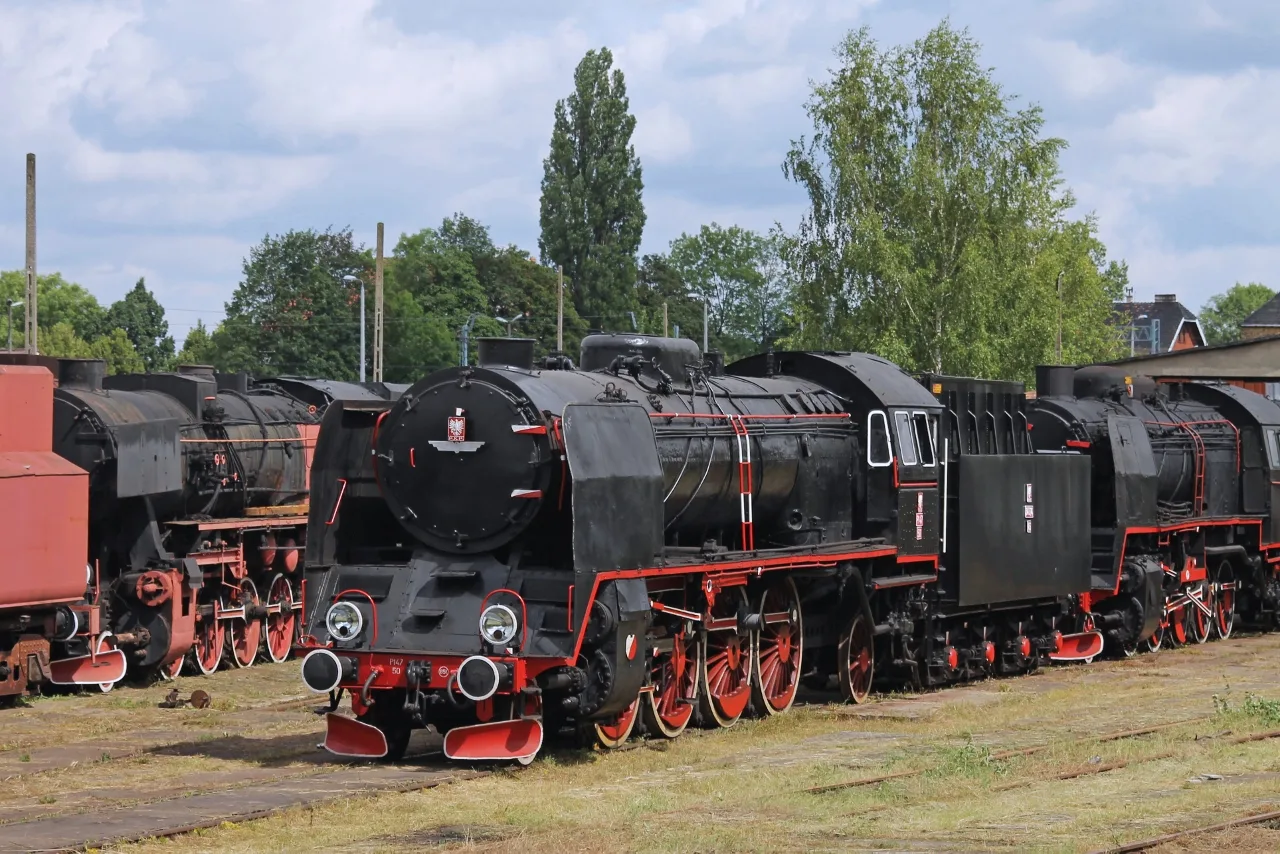

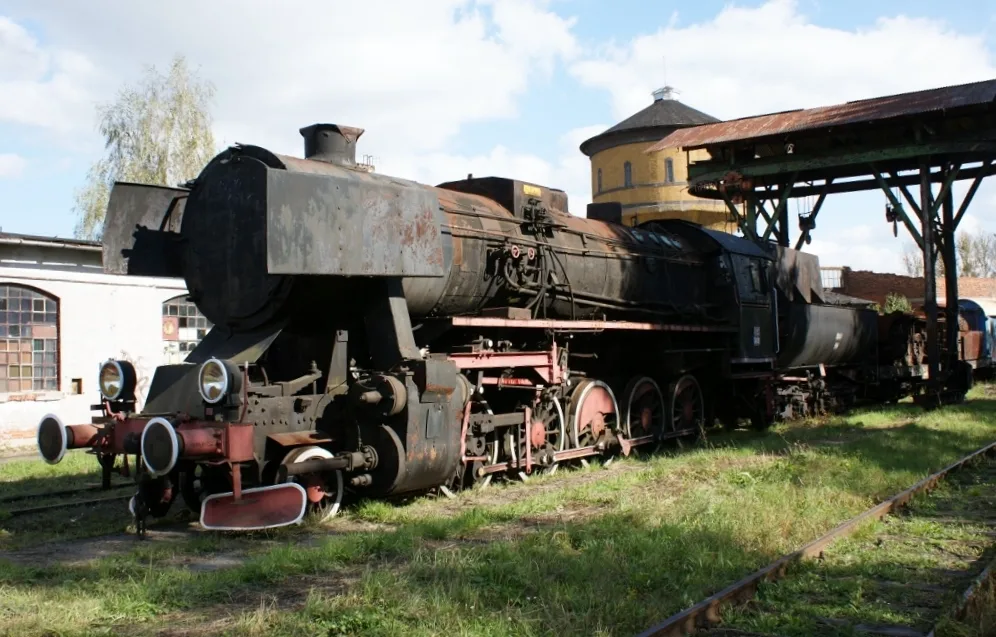
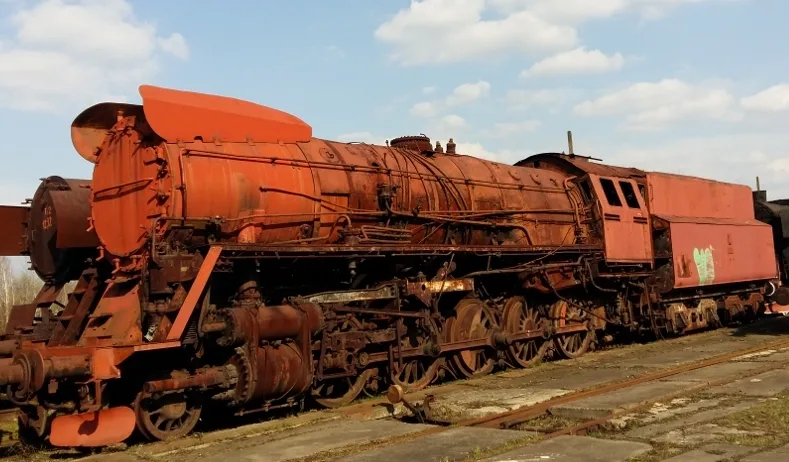
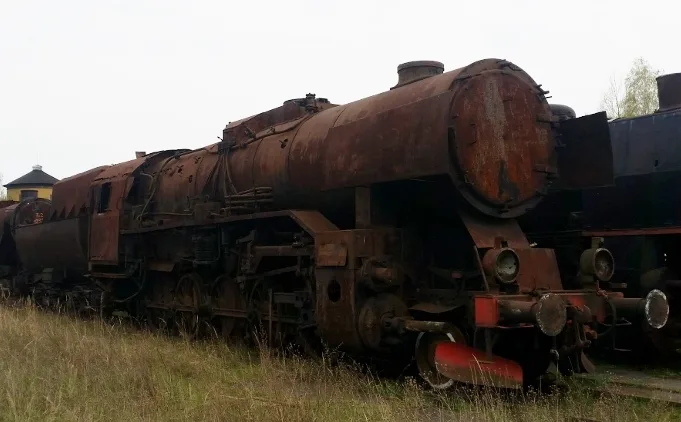
The highlights are standard-gauge PKP engines: express locomotive Pt47-50 (formerly a monument at Siedlce), passenger engines Ol49-15 and Ol49-90, wartime German “Kriegslok” Ty2s and their Polish post-war counterparts Ty42, Ty43, Ty45 and Ty51. A curiosity is TKpb3 14486, a Belgian engine from the early 20th century rebuilt in Wrocław in 1955.
The TKp “Śląsk” class
A special place belongs to the TKp “Śląsk” industrial tank engines (works type T2D). The Society owns seven built by Fablok and one German prototype-pattern engine built by Borsig in 1944. Fablok built them from 1950, based on the German “Oberschlesien” design, for mine and steelworks sidings. By November 1963, 406 had been built, 90 of them exported to China as class SLA59. The last, TKp 6293, went to the Gliwice coal mine. Over a dozen survive in Poland, and several more run on heritage railways in the UK, Belgium and the Netherlands.
| Parameter | TKp “Śląsk” |
|---|---|
| Builder’s type | T2D (Fablok) |
| Wheel arrangement | 0-4-0 (0-8-0T) |
| Cylinder bore × stroke | 550 × 550 mm |
| Boiler pressure | 1.4 MPa |
| Heating / superheater surface | 112.4 m² / 40 m² |
| Wheel diameter | 1100 mm |
| Maximum speed | 40 km/h |
| Service weight | 66 t |
| Water / coal capacity | 6.5 m³ / 3 t |
| Length | 10,980 mm |
Diesel locomotives
The oldest is Kö 0130 of 1934, according to the Society the oldest diesel locomotive in Poland. Most are industrial engines from Fablok and Zastal and Romanian LDH locomotives from FAUR in Bucharest. LDH18-001 is a small 21-tonne shunter of 1988 with a 132 kW Raba-MAN engine.
| Locomotive | Builder | Year | Last worked at | Status |
|---|---|---|---|---|
| Kö 0130 | – | 1934 | Polinova, Brzezinka | awaiting restoration |
| 409Da-254 | Zastal | – | Katowice Ligota | exhibit |
| 409Da-436 | Zastal | – | Montochem Gliwice | exhibit |
| 409Da-519 | Zastal | – | ZPW Goczałkowice | exhibit |
| 409D-104 | Zastal | – | Ustrzyki Dolne | exhibit |
| 410D-24 | ZZPK Zielona Góra, no. 24 | 1972 | Kielce | exhibit |
| Ls40-4122 | Fablok | – | ZKS Gliwice | exhibit |
| Ls40-4166 | Fablok, no. 4166 | – | Katowice Ligota | exhibit |
| Ls60-09 | Fablok | – | Metalchem Gliwice | exhibit |
| Ls60-293 | Zastal | – | – | exhibit |
| Ls300-774 | Fablok | – | PRTK Pyskowice | awaiting restoration |
| Ls300-948 | Fablok | – | steelworks Batory, Chorzów | exhibit |
| SM03-345 | Fablok, no. 6516 | 1965 | Ustrzyki Dolne | exhibit |
| SM03-403 | Fablok, no. 6202 | 1962 | Chrzanów | exhibit |
| SM40-10 | Ganz (Hungary) | 1958 | depot Stargard Szczeciński | exhibit |
| LDH18-001 | FAUR Bucharest | 1988 | state reserve depot, Opole | exhibit |
| LDH29-006 | FAUR Bucharest | – | Eurovia, Lubań Księginki | exhibit |
| LDH45-24 | FAUR Bucharest, no. 25392 | 1988 | Cargo Speed, Braniewo | – |
| LDH70-001 | FAUR Bucharest, no. 24557 | 1982 | steelworks Stalowa Wola | exhibit |
Passenger coaches
| Coach | Year | Builder | Last worked at | Status |
|---|---|---|---|---|
| F (baggage van) | 1914 | Königsfeld near Brno | PTKiGK Zabrze | exhibit |
| WLABd (sleeping car) | 1979 | Görlitz | Wars Wrocław | exhibit |
| Bhp (double-deck), 2 coaches | – | Görlitz | PKP Kędzierzyn-Koźle | exhibit |
| 43A | 1957 | HCP Poznań | PTKiGK Zabrze | awaiting restoration |
| 94AA no. 8542 | 1976 | ZNTK Opole | Węgorzewo | operational |
| 94AA no. 8543 | 1976 | ZNTK Opole | PCC Szczakowa | operational |
| 94AA no. 8544 | 1976 | ZNTK Opole | PCC Szczakowa | awaiting restoration |
| 94AB no. 8535 | 1977 | ZNTK Opole | Kętrzyn | operational |
| Bhux no. 8532 (saloon) | 1929 | Lilpop, Rau i Loewenstein | PCC Szczakowa | under repair |
| Bi29, 2 coaches | after 1929 | Gottfried Lindner | Nitron, Krupski Młyn | awaiting restoration |
| C „boczniak” | 1914 | – | Infrasilesia | awaiting restoration |
| 110Ac (couchette) | 1976 | HCP Poznań | Legnica | under repair |
| XHa (service van) | – | – | ZNTK Ostrów | awaiting restoration |
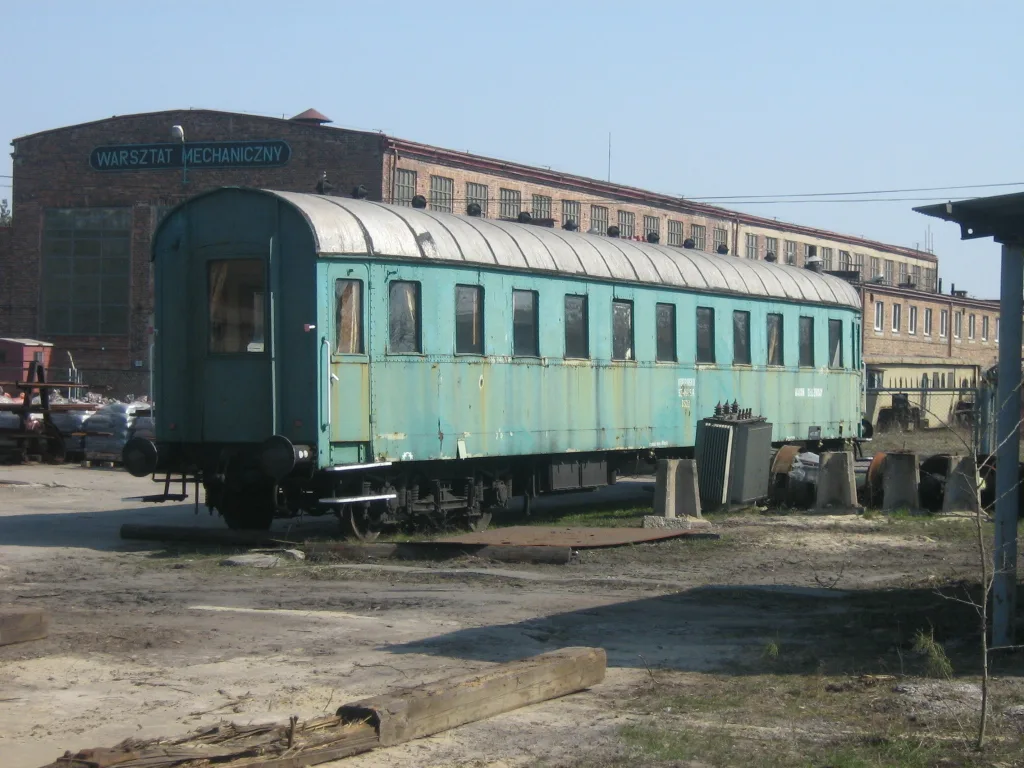
Three 94AA/94AB coaches from ZNTK Opole are operational and run in heritage trains behind Ty42-24. Saloon Bhux 8532 of 1929 (four axles, Görlitz bogies, 28 seats or 14 berths) and couchette 110Ac are under repair; the couchette was refurbished in 2019–2020 with support from PROTOR and GROWAG.
Freight wagons
The collection includes more than 20 freight wagons, among them sand hoppers 15W and 22W from the Szczakowa sand railway; tank wagons, including an Slr from the Chrobry coking plant in Wałbrzych; UNRRA covered van no. 8310; Kddt (Pafawag, 1951) and Kdt vans; a Prussian-type IId8 van of 1909; a Kassel A2Kdth van from Talbot of Aachen (1915); a 205S Sddw lime wagon from Pyskowice depot (c. 1968); a 3W Wddo coal wagon (Pafawag, 1946); a Kpt van from Huta Ostrów (1934); an XH from ZNTK Lubań (1961); flat wagons Rkmp from Prince Henri of Luxembourg (1911) and 412Za Rs (1978); an Italian van of 1910–1930 from Staszic coal mine and a Hungarian Kd van of c. 1920 from Piast coal mine.
Other vehicles
- electric multiple unit EW90-36 from the Szczakowa sand railway
- EDK-300 breakdown crane
- 32D46 tenders of Ty246-24 and Ty246-38 from Gliwice depot and a tender from Floridsdorf of Vienna
- a working hand draisine of 2016
TOZKiOS and Zrobotyzowani
In 2011 a team of TOZKiOS volunteers worked on the restoration of Ty42-44 and on moving the locomotives. Among them was Karol Lubaczewski, now president of Zrobotyzowani. His photos from those weeks are in our archive:
- Ty42-44: restoration at Katowice depot and return to Pyskowice, 2011 (in Polish)
- Pt47-50 and Ty42-44 at the Railway Technology Days in Gliwice, 2011 (in Polish)
See also in the Lexicon
- Wrocław Railway Enthusiasts’ Club (KSK) – now owner of TKh 05353, which TOZKiOS members helped overhaul
- Railway Museum in Silesia, Jaworzyna Śląska – home of the Steam Gala that Ty42-24 attends
- Chabówka railway open-air museum – roundhouse and working steam in Lesser Poland
- Skierniewice locomotive depot – historic depot near Warsaw
Getting there
The museum occupies the former locomotive depot by Pyskowice station. The easiest access is from ul. Piaskowa, via the steps between the railway bridges. Pyskowice is served by trains from Gliwice and Opole and by ZTM buses. Visits must be arranged with the Society in advance. Note: the Society’s former website is currently unsafe (it has been hijacked), so we do not link to it.
Frequently asked questions
What is TOZKiOS?
The Society for the Protection of Railway Heritage and Open-Air Museums is an association from Pyskowice that has been saving historic rolling stock since 1998 and is creating a museum in the former depot by Pyskowice station.
How many steam locomotives are there in Pyskowice?
According to the Society’s lists about 27, from express engine Pt47-50 and freight Ty2, Ty42, Ty45 and Ty51 to industrial TKp “Śląsk” tanks. The whole collection exceeds 60 vehicles.
Is Ty42-24 operational?
Yes. After a general overhaul Ty42-24 was approved for service on 18 June 2013 and hauls heritage trains, including to the Wolsztyn Steam Parade and the Jaworzyna Śląska Steam Gala.
Can I visit the Pyskowice museum?
Yes, but visits must be arranged with the Society in advance. Events and heritage-train runs are also a good opportunity.
How do I get to the TOZKiOS museum?
By train to Pyskowice (from Gliwice or Opole) or by ZTM bus. The easiest way into the former depot is from ul. Piaskowa, via the steps between the railway bridges.
What was the Pyskowice sand railway?
An industrial line that from the early 20th century carried backfill sand to Silesian coal mines. Huge TKz tank engines ran on it, and the last steam locomotive, Ty51-140, was retired on 15 April 1993.
Sources
- Archiwalna strona internetowa Towarzystwa, tozk.pl – podstrony „Historia”, „Kalendarium Ty42-24”, „Tabor” (stan z maja 2026, kopia z Internet Archive; bez odnośnika, bo serwis został przejęty i jest obecnie niebezpieczny). Opracowanie historii na tej stronie: Grzegorz Radliński.
- Krajowy Rejestr Sądowy, KRS 0000031208 (krs-pobierz.pl)
- M. Jerczyński, S. Koziarski, „150 lat kolei na Śląsku” (bibliografia przywoływana przez Towarzystwo)
- Wikipedia: Pyskowice (stacja kolejowa), Ty42
- Ilostan: baza taboru (Pt47-50, Ty42-44, Ty42-24)
- RailPictures.net: Ty42-24 TOZKiOS Pyskowice
- Urbex.nl: Lokomotywownia Pyskowice