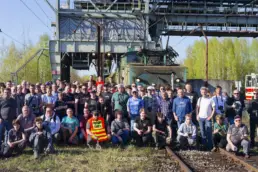
Zrobotyzowani Educational Path in collaboration with the University of Warsaw – Behind the scenes of a Polish supercomputer – an expedition of the Zrobotyzowani to the ICM Technology Center 🖥️
On December 16, 2025, we had an extraordinary opportunity to visit the Interdisciplinary Center for Mathematical and Computer Modeling of UW – specifically its state-of-the-art ICM Technology Center at ul. Kupieckka 32 on Warsaw’s Białołęka. From the very threshold we felt a thrill of excitement: after all, this is one of the most advanced centers of computational technology in Poland and one of the most modern in Europe. Our guides through this amazing place were ICM engineers, Messrs. Michał Dzikowski and Bartosz Drogosiewicz. After a brief introduction and putting on ID badges, we ventured into the depths of a building full of technological wonders, to see with our own eyes the heart of Polish supercomputing power!
Want to see with your own eyes how 6-ton spinning giants maintain the operation of a machine performing a billion operations per second?
Join our upcoming events and discover these and other secrets of the ICM Technology Center! Join us, subscribe to our newsletter!


Power that never fades – DRUPS power supply
Massive DRUPS power systems (Diesel Rotary UPS) stand guard over the uninterrupted operation of the supercomputer. In each of these four metallic giants, a huge flywheel weighing approximately 6 tons continuously rotates, acting as a reservoir of kinetic energy. An electric motor constantly maintains the rotation, and a generator connected to the internal shaft powers the facility – such an arrangement completely isolates the data center from external power grid fluctuations, and at the same time eliminates reactive power problems. When there is a power outage, the spinning mass immediately takes over the load, giving time to start a diesel engine coupled to the generator. Each DRUPS unit is a rather modest 16-cylinder diesel engine with a power of approximately 1.33 MW – and the center has four of them, which together provides over 5.3 MW of protected power for the servers. Moreover, in 2024 our guides had the opportunity to test these systems in battlefield conditions. As a result of a fire at a nearby shopping center, the entire ICM was cut off from grid power for several weeks. During that time the machines operated at half steam (but weather forecasts for the meteo.pl service still had to be calculated!), and the powerful generators burned the contents of a 1000-liter diesel tank twice a day. 😮 It would be hard to find a better reliability test – the DRUPS systems performed excellently, keeping the center running until external power was restored. By the way, we learned that some of the ICM server cabinets have their own small UPS units, although the data center industry is now moving away from overly elaborate emergency power systems. At such enormous power levels, it sometimes becomes unprofitable – sometimes it’s more sensible to simply safely shut down equipment and wait a moment for power to return, rather than invest in huge batteries. Fortunately, in our case this was not necessary – the large engines roared to life and kept the entire infrastructure operational.
Cool, safe, modern – technical curiosities of the data center
The next item on the agenda was security and cooling systems. Unfortunately, due to ongoing installation work (ICM is awaiting a Christmas gift in the form of a new supercomputer, arriving after New Year’s), we were unable to look into the main cooling machinery room. Perhaps next time! However, we did have the opportunity to see the advanced fire suppression system of the data center in action. It turned out that the center uses a unique combination of two fire suppression technologies: ultra-fine water mist and controlled reduction of oxygen levels in the data center atmosphere. In case of fire detection in the server chamber, batteries of gas cylinders would spring into action, reducing the oxygen level in the room to a value (~12%), at which fire cannot spread as quickly. The remaining areas are protected by a water mist system, which would fill the space within seconds with a cloud of delicate, high-pressure mist that suppresses flames without flooding equipment. Of course entry to server zones takes place through double airlocks, which prevent accidentally “pumping” fresh air back into the protected space. Each activation of the suppression system is also automatically reported to the Fire Department, which significantly speeds up firefighting operations. All to ensure that expensive equipment and invaluable data are safe 24 hours a day.
The server hall itself also hides several intriguing engineering solutions. We noticed, for example, that thick power cables don’t tangle at all underfoot – they were routed high, just under the ceiling, in the form of solid busway systems above rows of cabinets. If needed, additional equipment can be easily powered from them exactly where needed. Meanwhile, under the raised floor run pipes supplying cold glycol solution to all key components, and next to them space is left for cold air distribution. Any floor panel can be switched to perforated – thanks to this, cold air from air conditioning is forced under the floor and exactly where it’s needed, through gratings it reaches the front of the cabinets, cooling the overheated processors and drives. Our eyes even caught a dedicated cold aisle between rows of equipment. We saw how the front doors of the cabinets draw in icy air, which then escapes through the back of the housings to the warm part of the room – such an arrangement cold aisle/hot aisle is today’s world standard in data centers.
Want to feel the chill of the “cold aisle” and see systems that change air composition in a fraction of a second to suppress fire?
Join our upcoming events and we’ll take you where the digital heart of Polish science beats! Join us, subscribe to our newsletter!


Walking among the cabinets: from storage arrays to supercomputer
When we crossed the threshold of the actual server room, we felt somewhat like children in a toy store – around us towered rows of gleaming server cabinets, blinking with indicator lights, the muted hum of thousands of fans audible. Our guides directed us first to a separate aisle filled with auxiliary equipment. From time to time we heard with a smile: “this is still not the supercomputer” – but there was plenty to see! 😃 Around us were powerful disk arrays with a total capacity of over 20 petabytes (the ICM Tetyda storage system), blinking servers and stacks of network switches with throughput of 100 Gb/s or higher. Hundreds of fiber optics and copper cables connected it all into one network. The cabinets in this section are responsible for data storage and preprocessing, as well as communications – the true backbone of the supercomputer. This section of the room has its own cooling circuit: cold air is forced directly into the closed front aisle, and after flowing through the heated equipment, it escapes already warm behind their backs. After admiring these “backbone” wonders of technology for a while, we moved on to the next rows of cabinets.
The deeper into the server room, the more zeros and ones surrounded us – literally! Terabytes, nay – petabytes – of data, hundreds of processors, tens of thousands of cores… Blinking lights, cabinets full of drives and computing units – like a scene from the movie “Don’t Worry, It’s Just a Breakdown” – it all made a huge impression on our imagination. However, the real hero was lurking at the very end of the hall. There, behind an unassuming partition, it was waiting for us.
A row of black Cray XC40 cabinets – this is Okeanos, the legendary ICM supercomputer. This unassuming yet powerful construction is the computational heart of the center. Okeanos consists of 6 interconnected cabinets, each filled with electronics driving calculations on an unprecedented scale. This supercomputer launched in 2016, the Cray XC40, delivers over 1 petaflop of computing power (10^15 operations per second!) and has become famous, among other things, as the machine generating weather forecasts for the meteo.pl service. However, it is used in all fields of science – from astrophysics to biology – wherever an enormous number of parallel calculations are needed. Looking at its endless array of modules, we were aware that we stood before hundreds of thousands of times greater computing power than a home PC. We truly felt respect!


Okeanos supercomputer – selected parameters:
- Architecture: Cray XC40, launched in July 2016.
- Number of nodes: 1084 compute nodes, each with 2 Intel Xeon E5-2690v3 processors (Haswell, 12 cores per CPU) – for a total of 24 cores and 128 GB RAM per node. In total, this gives an impressive 26,016 CPU cores and over 138 TB of operational memory across the entire system!
- Inter-node network: super-fast Cray Aries network with Dragonfly topology (special routers connect nodes with enormous bandwidth).
- Performance: >1 PFLOPS (maximum computing power exceeds 1 quadrillion operations per second).
Unfortunately, we couldn’t look inside Okeanos – Cray engineers made sure to keep curious hands away from the most important components. 😉 Upon opening the cabinet doors, our eyes were presented only with tightly packed blade modules, which lacked only a “No entry” sign. As the guides explained, Okeanos arrived at ICM as a ready-made “black box” – or rather, a series of ready-made cabinets that only needed to be connected to power, network, and… water. Yes – water cooling is the foundation of this colossus’s operation. In each module, water circuits circulate, removing heat from processors and memory and then dissipating it in dedicated heat exchangers to the main cooling system.
However, time stands still for no one, not even supercomputers. Today, after more than 8 years of continuous operation, Okeanos has become a technological senior – still impressive, but falling short in energy efficiency compared to the newest designs. To put it bluntly, keeping it running costs more and more electricity, while new units can provide higher computing power while using significantly less energy. And that’s precisely why right next to it, installation of its successor is already underway. We watched with excitement for signs of this change: in the data center we could see empty space prepared for new equipment, and technicians were already running more pipes and cables there. The new ICM supercomputer – set to start operating in early 2026 – will be cooled directly with water and equipped with the latest processors and accelerators, which will allow saving a lot of energy. We can’t wait to see it in action during our next visit!
It’s worth noting that Okeanos is not the only “brain” of this center. ICM also has other specialized HPC machines, which we had the opportunity to see along the way between server racks:
- Enigma – a computing cloud based on Huawei servers (launched in 2016), equipped with approximately 8,000 CPU cores and over 8 petabytes of disk space, serving advanced data analysis. It is on this machine that projects requiring fast processing of huge amounts of information (Apache Spark, etc.) are realized.
- Rysy – a GPU cluster consisting of several computing nodes containing the most powerful NVIDIA accelerators (including Tesla V100 32GB cards). In total, the system operates a dozen or so GPU devices, making it an ideal tool for artificial intelligence, machine learning and simulation tasks requiring parallel GPU processing.
Let’s add that the entire complex was designed with the future in mind – we learned that right next to the current data center there is a second, twin hall with comparable area of ~500 m². This is impressive – in one building sleeps the potential for a significant increase in computing power in the future!


Arctic air on the roof
After an intense walk among the cabinets, it was time to literally get some fresh air. We climbed with the guides onto the roof of the ICM Technology Center to see what was happening above the data center.
Panorama of the ICM Technology Center roof – a view of massive cooling units and a dense network of surge protection cables. Beneath this web of copper wires stretched along the roof hides a complex system of data center cooling. It is here that heat from the supercomputers is released to the atmosphere using a series of massive dry-coolers (air coolers) and cooling towers. At the time of our visit, some equipment was actually turned off – they were undergoing modernization and adjustment for the requirements of the new HPC, which would soon take the place of Okeanos. From the roof, there was an impressive view of the surrounding campus area – in the distance we could see the burnt-out skeleton of a nearby shopping center (the source of the recent emergency power tests 😉), as well as production halls where huge concrete tubings were once made for the II line of the Warsaw metro. In such an unusual setting, we discussed infrastructure redundancy – including how the building has independent power connections from two different transformer stations and a multi-stage power backup system (which we had already seen). It was getting late, the sun was setting on the horizon, and we still had one unique point on the program ahead of us…


History that lives – ICM Computer Museum
The final stage of our expedition was a visit to a place where time seemed to stand still – at least at first glance. In the basement of the modern center, there is a Computer Museum of ICM – the youngest museum of the University of Warsaw, opened in September 2025. This institution was created to preserve for posterity an impressive collection of hardware that for decades powered Polish science. For technology enthusiasts, this place is absolutely magical.
The exhibition in the ICM Computer Museum allows for a journey through time in the history of supercomputers. In a hall with an area of over 300 m², historical equipment once used in ICM is presented – from huge cabinets full of electronics from the 1990s, through computing clusters from the first decade of the 21st century, to various mass storage systems and access terminals from the pre-Internet era. The participants of our tour admired these digital treasures with great interest – each exhibit is a separate story about how enormous progress was made in computer science over just one generation.
There were no shortage of elements straight out of pop culture. We came across, for instance, equipment that looked like an elegant coffee maker – it turned out to be a cult SGI server from the 1990s, the type of computers on which the Pixar studio created the first animations for the film Toy Story! 🤩 Right next to it were stacks of operational memory modules occupying half a cabinet – once they were hundreds of megabytes, and today they fit in a pocket USB drive. In another corner were processors the size of a brick – once the heart of a Cray supercomputer, today an interesting exhibit showing how miniaturization changed everything. We also found old network switches, data carriers with comically small capacity from today’s perspective, and even fragments of early computer terminals from which scientists once connected to ICM over the network. All of this is unique technological heritage, which ICM decided to preserve to inspire generations of engineers to come.


Emotions, conclusions and… see you again!
After many hours of touring, we returned home full of impressions. We were there, we saw with our own eyes supercomputers and infrastructure known only to a select few in everyday life – and we felt enormous admiration for the people who design and maintain it all. The ICM Technology Center is not just a data center – it is a true temple of science and technology, a place where industry meets science, and the present meets the future. Thanks to our guides, we learned many interesting facts, touched technology that is not accessible in everyday life and became convinced of what the background of projects that change the world of science looks like.
If you’re still wondering whether it’s worth taking part in upcoming expeditions with Zrobotyzowani, our report speaks for itself. You won’t find such unique experiences anywhere else! This is #industrialtourism at its finest – combining passion, knowledge and emotions. We can hardly wait for the next adventure, and in the meantime we remain deeply impressed by what the Interdisciplinary Center for Mathematical and Computer Modeling of UW kept hidden from us.
See you on the next expeditions! 👋

Thanks
We extend special thanks to our guides – Bartosz Drogosiewicz and Michał Dzikowski. Thanks to your knowledge, involvement and patience, even the most complex technical issues became clear, and every question was met with substantive and comprehensive answers.
We extend our enormous thanks to the entire team of the Interdisciplinary Center for Mathematical and Computer Modeling of the University of Warsaw for extraordinary openness, the opportunity to organize an inspiring tour and perfect coordination of the entire event. We are extremely grateful for the patience with our numerous questions and unabated photographic enthusiasm that accompanied us during our tour of one of the most important computing centers in Poland.
Thank you!
Keywords: industrial tourism, data center tour, Okeanos supercomputer, ICM Technology Center, ICM UW, supercomputer tour, Cray XC40, DRUPS systems, backup power, ICM Computer Museum, technology, day trip with guide, event report, Zrobotyzowani, industrial photography, technology from the inside, critical infrastructure, IT behind the scenes.
Sounds like a great day well spent? See where we’re heading in the coming time:
Want to experience a similar adventure? Industrial tourism with Zrobotyzowani means access to unique objects and places that many have no idea exist.
👉 Join us! Follow upcoming events at Zrobotyzowani.com.pl and subscribe to our newsletter so you don’t miss the next registrations. 👉 Express your passion: Check out our Zrobki.pl store for gadgets for industrial fans!
Zrobotyzowani #ICM #Warsaw #Białołęka #IndustrialTourism #IndustrialTourism #Supercomputer #Okeanos #CrayXC40 #DataCenter #ServerRoom #Technology #DRUPS #EmergencyPower #MetEoPL #ComputerMuseum #Photography #IndustrialPhotography #Exploration #PolandForTheWeekend #Mazovia #TechnicalTour #CriticalInfrastructure #HighPerformanceComputing #ITFromBehindTheScenes #HistoryOfTechnology #SGI #SmallAndBigJourneys #CyberSecurity #TravelPoland
Photos taken by: Andrzej Cabal Kwiatkowski and Karol Lubaczewski
Report prepared by: Paulina Kozłowska, Andrzej Cabal Kwiatkowski, Karol Lubaczewski, under the watchful eye of invaluable guides Michał Dzikowski and Bartosz Drogosiewicz