Zrobotyzowani Educational Path in cooperation with ArcelorMittal Poland – A hot Zrobotyzowani tour to the Hot Rolling Mill (BWG) at ArcelorMittal Poland ⚒️
When we stand in front of the Hot Rolling Mill hall at the ArcelorMittal steelworks in Kraków (formerly the Sendzimir Steelworks), the first thing that strikes us is the silence. From the outside, it looks like an “ordinary” industrial colossus – steel, glass, rows of windows. But you only need to cross the gate to enter a world where steel flows like lava, and tens of megawatts of power turn massive blocks of metal into a thin strip just 1.4 mm thick.
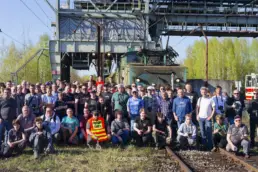
Last Friday, it was here that our Zrobotyzowani team, together with our guide Mr. Rafał Paradowski (Support Manager at ArcelorMittal Poland), set off on a unique tourism-industrial expedition to the ArcelorMittal Hot Rolling Mill at the former Sendzimir plant in Kraków. From the very first moments, we felt this wouldn’t be an ordinary tour – massive machines, sizzling furnaces, and winding ribbons of hot steel simply mesmerized us. We were there, we saw with our own eyes a piece of Poland’s industrial “technical heritage,” and we want to share every detail of this expedition with you!
Want to see how 25-ton steel blocks transform into kilometer-long strips of sheet metal right before your eyes?
Join our upcoming events to discover this and other secrets of the Hot Rolling Mill!
From blast furnaces to a modern rolling mill – a brief history of the steel city
Mr. Rafał begins with the story of the steelworks itself. The former Lenin Steelworks, later the Tadeusz Sendzimir Steelworks, and today ArcelorMittal Poland – a massive, multi-stage metallurgical complex that for decades had it all: blast furnaces, steel plants, coke ovens, hot and cold rolling mills. The history of the Kraków plant began in 1954, and by the 1970s, production reached about 6–7 million tons annually, with the plant boasting 12 coke batteries, 5 blast furnaces, and a Martin open-hearth steel plant.
After the political transformation, the steelworks came under the wing of the ArcelorMittal concern. Under the privatization agreement, the new owner was obligated to build a modern hot rolling mill. Construction started in 2005, and as early as 2007, the first slab was heated in the new furnace. Within a few months of full production, the old hot rolling mill was no longer needed – it was shut down and its equipment dismantled. Today, the concern has invested over 3 billion PLN in the Sendzimir Steelworks since 2004, and the hot rolling mill alone absorbed approx. 1.2 billion PLN and is still considered the most modern rolling mill in Europe.
Today, the raw materials section in Kraków is not operating – in 2020, the blast furnaces and steel plant were permanently shut down. But the hot rolling mill is still fully alive, processing semi-finished steel products (slabs) brought in from other group plants, not just from Poland. After building a second reheating furnace, the rolling line achieved a capacity of around 3.3 million tons annually, whereas previously it was approx. 2.3 million tons. In practice – a single line is capable of “passing” through itself as much steel annually as the weight of a small city.
To transport hot slabs, so-called thermos wagons are often used, developed specifically for the Hot Rolling Mill on Samms wagons.


This is where hot-rolled coils are produced, which later go to, among others:
- the cold rolling mill,
- organic coating plants,
- manufacturers of structures, profiles, pipes,
- the automotive and railway industries.
On the operator’s bridge – first contact with living steel
First stop of the tour: the charging operator’s bridge, overlooking the “parking lot” of slabs – huge steel blocks. Each slab has:
- length from 6 to 11 meters,
- thickness 220 to 250 mm,
- width from 0.7 to 2.1 meters,
- weight up to 35 tons, but typically around 25 tons.
Raw steel blocks arrive by train from Dąbrowa Górnicza. Railway vehicles bring two slabs per wagon, separated by wooden sleepers. Operators on the bridge measure each slab, check its number and destination, according to the production plan which determines: which block goes into the furnace, in what order, and what final product it will be processed into.


Rafał explains the principle of charge selection:
“We don’t choose slabs blindly. For each order, we have to match the appropriate width, steel grade, and weight. We can reduce width by a maximum of about 100 mm – if a slab is a meter wide, we’ll make a sheet 900 mm wide, but not 700.”
That is why in production planning, the slab widths are very precisely matched to the target sheet widths – usually, the slab is 20–30 mm wider, so it can be gently “trimmed” by the rolling process, while leaving a margin for errors and fluctuations.
Would you like to come face to face with the power of glowing steel and feel the heat of the reheating furnaces?
Join our upcoming events to discover this and other secrets of the Hot Rolling Mill!
Reheating furnaces – where steel becomes orange lava
We head down towards the heart of the hot rolling mill – the reheating furnaces. This is where cold, massive slabs turn into hot, pliable “loaves” of steel. Slabs go into one of two massive walking beam furnaces (the “old” and the “new” furnace), where they are heated to a temperature of about 1230°C – this is needed for the steel to become soft enough to be rolled, but still maintain its structure.
Heating time depends on the steel grade – usually it takes from 2.5 to 4 hours (approx. 140–220 minutes) in the furnace to obtain evenly heated material. The furnaces, several meters high, look like huge rectangular halls encased in hundreds of meters of pipes supplying gas and air to the burners.


Rafał shows us thermocouples and inspection “windows” through which workers control the heating process. The furnace is divided into zones where independent control is maintained over:
- gas supply,
- air volume,
- temperature inside the furnace chamber
For industrial tourists, this is a true paradise: giant heat exchangers, compressed air systems, gas installations, reduction stations. Imagine a corridor full of pipes, valves, and pressure gauges, where every element has its task in maintaining stable thermal conditions.
Rafał honestly cools our photographic enthusiasm – explaining that photos of the most sensitive installations must pass internal authorization. For Zrobotyzowani, this is standard – safety and confidentiality always take precedence over a spectacular shot.
Descaling – a shower under pressure
When the slab reaches the right temperature, it exits the furnace onto transport rollers. During heating, a layer of scale forms on its surface – a hard, oxidized layer that must not be left on the sheets.
That is why the first stage after exiting the furnace is descaling – the steel gets a “shower” with water under very high pressure. Water jets knock off the unwanted layer and slightly cool the material surface. Under the roller table, a peculiar steel-water stream is formed: a mixture of water and scale goes to special channels, where it is cooled and cleaned – the water returns to circulation, and the scale can be sold or utilized.
Roughing mill – five to seven passes
The next stage is the roughing stand (roughing mill). Here the slab – still hot as lava – enters between massive rolls and is rolled in five or seven passes. Each pass means a run in one direction – the steel turns back again and again, becoming thinner and longer with every moment.


Parameters after the roughing mill:
- thickness: from 30 to 55 mm,
- width: still up to 2.1 m,
- temperature still very high, over 1000 degrees.
Finishing mill – six stands and a race against time
After roughing, the strip goes to a set of six finishing stands (finishing mill). Here everything happens continuously – the strip speeds through successive rolls, and each stand reduces its thickness and controls the profile. It is this part of the process that determines what final thickness our sheet will have.
For “standard” products, the range is wide, but for us, the extremes are most interesting:
- the thinnest sheets leave the line with a thickness of approx. 1.4 mm – a steel equivalent of cardboard, but still weighing tons,
- typical strips are 2–8 mm,
- on the “heavy” side, sheets of a dozen or so millimeters are produced, using less extreme rolling parameters.
- Additionally, at the last stage, on the last rolling stand, the sheet can receive an anti-slip texture – thanks to a special roll with a “tear drop” pattern.


The campaign of finishing rolls – i.e., the period between their grinding and replacement – involves approx. 2500 tons of processed material, and detailed instructions regarding rolling campaign rules take up over 30 pages of documentation.
Rafał talks about how important it is to maintain flatness and even temperature distribution. Too large differences, setting errors, or uneven heating can cause quality defects, and excessive roll wear causes a phenomenon the steelworks calls “cat ears” – a characteristic curling of edges on the strip cross-section.
For us – technical geeks – this is pure poetry of the process: immense pressure forces, precision counting in tenths of a millimeter, and all this controlled from an air-conditioned pulpit full of screens and charts.
150 meters of steel sprint – cooling section
After the last finishing stand, the strip goes to the cooling section. This is where the precise battle for the final mechanical properties of the steel takes place.
From the last roll to the coiler is approx. 150 meters of roller tables, of which approx. 112 meters is the “wet section” – a dense battery of water nozzles above and below the strip, controlled separately in several zones.
Rafał explains cooling strategies:
- standard steel is cooled so that before coiling it has about 500-600°C,
- for some grades – e.g., dual-phase steels for the automotive industry – extremely fast cooling is used, even down to approx. 150°C just before coiling, which freezes a specific phase structure of the material and gives the appropriate combination of strength and plasticity,
- there are also grades where water is practically not used – the steel cools slower, which favors other properties.
We observe the image of the heated strip, which under the battery of nozzles changes from intense orange to dark red glow, until finally it becomes visually “cold,” although inside it still has several hundred degrees. For us, this is one of the most fascinating moments of the tour.


Coilers – when 1.5 km of steel turns into one coil
At the end of the line wait coilers – massive drums that grab the beginning of the strip and wind it up, turning it into a coil of sheet metal.
A few impressive numbers:
- maximum weight of a single coil: 35 tons,
- coil height: up to 2.2 m,
- strip length in one coil for thin sheets (approx. 2 mm and less): even 1.5 km, with one coil always being made from one slab.
Imagine this: steel “spaghetti” which, when unrolled, could connect two distant railway stops in a city, yet still fits on one drum. We saw a coil emerging from the coiler, which is then moved by a conveyor, secured with banding in a packaging machine, labeled, and then transported by a crane using a huge grabber.
Rafał tells how important it is to maintain constant tension of the strip between finishing and the coiler – so that no creases, waves, or breaks occur. Line controllers monitor in real-time the relationship between:
- rolling speed,
- coiling speed,
- strip temperature,
With thin sheets, the margin for error is minimal – a moment of inattention is enough for the steel to behave like an overly tightened tape.
Quality under the magnifying glass – cameras, laboratories, and coil classification
The coiler is not the end of the road. Each coil undergoes quality control, involving several teams:
- line operators,
- quality laboratory,
- camera system for surface inspection.
The finished coil is immediately marked by an automatic robot, which paints its number and parameters on the side and outer wrap. Directly on the line, an operator works to monitor dimensional parameters of the sheet – width, thickness, edge straightness, and the quality of both material surfaces. They are assisted by a surface inspection system, composed of line cameras that automatically detect and classify defects: scratches, inclusions, pits, dents, and others.
If a coil has a quality defect, one can:
- reclassify the coil to a lower quality class (e.g., for non-visible, structural applications),
- offer it to the Client on a concession basis,
- in an extreme case – scrap it.
Rafał emphasizes how important the quality of the produced material is: “At ArcelorMittal Poland, safety is our highest priority, quality comes second, and production realization ranks only third. We cannot afford to produce material that does not meet quality requirements, because it is Customer satisfaction that allows us to continuously develop and maintain our position as a leader in the steel industry.“
Finished coils are transported by internal rail transport from the hot rolling mill to further plants, where they can undergo subsequent processes: cold rolling, pickling, oiling, organic coating, galvanizing, cutting, or go to the finishing hall, from where, in hot-rolled condition, they are directly sent to Clients by rail or road transport after prior quality control and packaging.
It is worth mentioning that fewer than 1% of production has any defects!


People of the rolling mill – how many people operate the steel colossus?
One of the most frequent questions asked during our tours is: “How many people are needed to make all this work?”.
Rafał’s answer surprises many participants – the entire hot rolling line is operated by approx. 30 people per shift:
- production operators at the slab yard and loading operators
- shift foreman, operators of heating furnaces, roughing mill, and finishing stands,
- coiler and shipping operators,
- maintenance foreman, mechanics, electricians, automation specialists, power engineers,
- plus crane operators (about 6–7 people), formally part of the transport department, but working shoulder to shoulder with the rolling mill.
It’s impressive – hundreds of meters of line, megawatts of power, thousands of tons of steel daily and a crew of only thirty-something people coordinating it all.
Safety first – Health and Safety in steel version
Before entering the hall, Rafał discussed Health and Safety rules very thoroughly:
- helmets, glasses, earmuffs, safety shoes, and flame-retardant clothing are mandatory,
- we do not enter railway or truck tracks without explicit permission,
- we keep a minimum of 3 meters from tracks – even if “nothing is coming”,
- we do not walk under loads hanging on cranes – minimum “load height = distance from the crane track axis”,
- we do not touch any steel elements – even if they “look cold”, they may be several hundred degrees hot.
Zrobotyzowani treat safety during industrial plant tours very seriously. These are places where production is in full swing – we are only guests here. Therefore, we always operate in close cooperation with the hosts, and our groups are disciplined.
At the end of the tour, we thanked the participants for their exemplary attitude – zero incidents, zero stumbles, even though we moved through truly demanding terrain.
From the rolling mill to the world – where does Krakow’s sheet metal go?
At one of the last stops, we look at worn-out rolls – massive steel cylinders that, after regeneration, can get a second life. Some of them go to the railway and construction industries, turning into elements of wagons, platforms, and working platforms.
And what about the sheet metal itself? During the tour, a whole list of applications comes up:
- steel structures – bridges, halls, girders, load-bearing elements,
- railway industry – wagon bodies, platforms, steps,
- automotive – structural parts, body reinforcements, rims, and wheels,
- machinery industry – bodies, covers, device elements,
- energy industry – tanks, installation support structures,
- further processing in cold rolling mills and coating lines.
Every time you see a steel structure, a railway wagon, a viaduct, or a massive tank next time – there is a good chance that somewhere inside lies steel that once passed through hot rolls in Kraków.
Hot emotions – our impressions from the visit
Visiting the hot rolling mill hall was a real roller coaster ride! When we walked among the machines, we heard the mighty roar of the rolling mill and felt the hot air beating from the furnaces. The room walls trembled from vibrations – every step underfoot sounded with a metallic echo.
With delight, we watched fiery beams in the furnace, where the slab turned into a ruby-red lump, and then we ran after the moving steel strips like following the cables of a giant instructor. Andrzej stated that he felt like he was on Mars when he saw the flame in the furnace; Paulina couldn’t take her eyes off the spinning steel strip before the coiler; while Karol couldn’t get over how quickly each coil arrived at the warehouse.
We were hugely impressed by the precision and scale of production. A thrill of adrenaline ran through kilometers of pipes and motors when we realized that we were witnessing the creation of massive sheets from which, for example, ship hulls or wind farm panels will be built. The moment when a huge coil settled silently on the platform caused applause from our group – it was the culmination of our tour.
If you are still wondering whether it is worth taking part in future expeditions with Zrobotyzowani, our report speaks for itself. You won’t find such unique experiences anywhere else! This is #industrialtourism at the highest level – combining passion, knowledge, and emotions. We can’t wait for the next adventure, and in the meantime, we remain under the great impression of what the Hot Rolling Mill hid from us.
See you on the next expeditions! 👋
Acknowledgments
Special thanks go to our guide and originator – Rafał Paradowski, Support Manager at ArcelorMittal Poland. Thanks to your knowledge and patience, even the most complicated technical issues became understandable, and every question found an exhaustive answer.
Huge thanks are also due to the entire ArcelorMittal Poland crew for their openness and consent to the tour, efficient organization, and great patience with our questions and photographic enthusiasm.
Thank you!
Keywords: industrial tourism, visiting the steelworks, visiting the rolling mill, ArcelorMittal Poland, ArcelorMittal Sendzimir, Rolling Mill Tour, Steelworks Tour, ArcelorMittal Urbex Tour, technology, one-day guided tour, event report, Zrobotyzowani, industrial photos, industry from the inside.

Sounds like a great day out? See where else we are going in the near future:
Want to experience a similar adventure? Industrial tourism with Zrobotyzowani means access to unique facilities and places that many have no idea exist.
👉 Join us! Follow upcoming events on Zrobotyzowani.com.pl and sign up for our newsletter so you don’t miss the next registrations. 👉 Express your passion: Visit our shop Zrobki.pl for gadgets for industrial fans!
#Zrobotyzowani #ArcelorMittalPoland #Kraków #IndustrialTourism #IndustrialTourism #UrbexPolska #Rolling #Metallurgy #Technology #BWGHotRollingMill #Sendzimir #SteelworksKraków #Photography #IndustrialPhotography #Exploration #PolandForWeekend #Małopolska #TechnicalSightseeing #RollingMill #Steelworker #SheetMetal #HistoryOfTechnology #SteamEngine #TravelsSmallAndBig #ActiveRest #IndustrialHeritage #UndergroundWorld #ironworksExploration #AdventureTime #TravelPoland
Photos by: Karol Lubaczewski
Report prepared by Karol Lubaczewski, under the watchful eye of the invaluable Rafał Paradowski