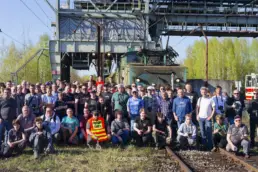
Date: May 23, 2025 | Location: Solina-Myczkowce Hydroelectric Power Plant Complex | Mission: Turbines Uncovered


A rainy, chilly morning in the Bieszczady Mountains means tea under a blanket for most people. For us? It’s the perfect backdrop for a technical adventure. On Friday, May 23, 2025, the Zrobotyzowani crew set out on an exclusive expedition to the Solina-Myczkowce Hydroelectric Power Plant Complex. The goal was simple: to see what is usually hidden behind thick dam walls and “No Entry” signs.
Our visit to the Solina Hydroelectric Power Plant began with a solid dose of knowledge, which quickly made us realize that this place is not just a vacation attraction, but a key element of the Polish energy system. Although most people associate it with sailboats and views of the dam, Solina is actually the third most powerful pumped-storage power plant in Poland – second only to the giants in Żarnowiec (750 MW) and Porąbka-Żar (500 MW).
We started the tour classically: with a short film about the history of the Solina Hydroelectric Power Plant Complex, which introduced us to the world of hydropower and showed how important this installation is for the stability of the national grid. Right from the start, a fact was mentioned that impresses even laypeople: in the event of a blackout, Solina can perform a full start-up, lubrication, cooling, and begin rebuilding the power system in just four minutes. It is precisely such facilities that allow the country to be brought back to life after a failure.
We also learned the basics of how the Polish power system works – from the capacity market, which ensures readiness to operate, to the balancing market, which ensures real-time stability. This made it easier to understand why the Solina Hydroelectric Power Plant is such an important “energy storage” and grid stabilizer.
During the presentation, an interesting fact also emerged that we had no idea about before: the construction of a new pumped-storage power plant on Jawor Mountain was being considered. Such an investment would require modernization of the Solina–PSE connection to the highest voltage grid, which only emphasizes the scale of the project.
And speaking of interesting facts – we were most surprised by the way the two units pumping water upwards are started. The start takes place “dry” — first, compressed air pushes water out of the pump chamber, preparing the entire system for operation. And here begins the real engineering drama, because there are two completely different start-up methods.
The first is an elegant and controlled method: the inverter slowly accelerates the turbine to synchronous frequency, and only then is the system smoothly connected to the power grid. No rush, full technical culture.
The second method… well, that’s a completely different school of driving. “Full throttle” — brutally, immediately, without half-measures. Effective? Of course. Gentle? Not at all. And the effect of such a start can reportedly even be felt in Lesko.
Do you want to see with your own eyes how 760,000 m³ of concrete holds back billions of liters of water, and powerful turbine pumps change the direction of the river in a fraction of a second to save the national energy system? Join our upcoming events and discover these and other secrets of Hydroelectric Power Plants! Join us, subscribe to our newsletter! Don’t be an ordinary tourist – become Zrobotyzowany!


Control Room – the true command center of the power plant
The next stage of our visit was the control room, which is the heart and brain of the entire Solina Hydroelectric Power Plant. This is where the operation of the facility is coordinated, responses to changes in the energy system are made, and decisions are taken that have a real impact on the safety of the region.
In emergency situations or during full power operation, the control room can be bustling with life – then the staff consists of up to 16 specialists. On a daily basis, however, three people are enough to monitor the stability and efficiency of the power plant’s operation.
Before us was the dispatcher’s workstation: a desk filled with a dozen or so monitors, on which key operating parameters are displayed in real time. We saw, among other things, continuous temperature measurements of turbogenerators, data on flows, loads, and equipment status. Every change, every deviation from the norm is immediately visible.
This is where operational decisions are made that affect the safety of the power plant and surrounding communities. However, the nature of work and power delivered to the grid is decided by the Polish Power Grids – Solina executes their orders, serving as one of the most important stabilizers of the national energy system.
Machine Hall – the heart of the power plant and an impressive overhaul
The most unique moment of the entire tour was the visit to the machine hall – a place that only a few reach on a daily basis. It was here, in the very heart of the Solina Hydroelectric Power Plant, that we could see up close the major overhaul of turbogenerators, carried out after more than 25 years of trouble-free operation. Such an opportunity is truly rare.
Before our eyes, turbogenerator No. 4 was already in full glory after the completed overhaul, while turbogenerator No. 3 was undergoing work. Both units are not just energy generators – they are turbine pumps that are responsible for pumping water between the Solina and Myczkowce Lake reservoirs, playing a key role in the operation of the pumped-storage power plant.
During the overhaul, a whole range of specialized activities is performed. One of the most important is rotor balancing – an extremely precise operation on which the efficiency, stability, and longevity of the entire system depend. This is work that requires experience, accuracy, and enormous technical knowledge.
In the past, units were overhauled on a cycle of “one unit per year“. However, after a major modernization carried out in 2000, only now has the need arisen to carry out such extensive work. This shows how solidly designed and operated the equipment working in Solina is.
Have you ever wondered what it’s like to stand under a supply pipe with a gigantic cross-section or listen to the echo in concrete galleries hidden deep under the lake bottom, where eternal silence reigns and a constant 6–8°C? Join our upcoming events and discover these and other secrets of Pumped-Storage Power Plants! Join us, subscribe to our newsletter! Don’t be an ordinary tourist – become Zrobotyzowany!
Turbine Hall – behind the scenes of the power plant, where no one usually looks
We directed our further steps to the turbine hall located directly below the machine hall. This is a space that participants of standard tours do not reach, and therefore exactly the kind of place that Zrobotyzowani like most – technical, raw, and full of engineering secrets.
This is where we could see turbogenerators from below, along with all the facilities that remain invisible on a daily basis: filtration systems, oil tanks, pollution separation installations. Every element of this infrastructure works in the background, ensuring the reliability and safety of the entire system.
The biggest impression was made by turbogenerator No. 4, which after the overhaul looked like new – we could see it from a perspective that cannot be seen anywhere else. Right next to it, at the work site of turbogenerator No. 3, intensive overhaul was underway. The sign “Work Site” left no doubt that we were in a zone where real engineering is happening. From a certain distance, the installation site could be seen – only the outer ring of blades directing water to the turbine remained there, like an open frame waiting for the heart of the entire system.
Going even lower, below the turbine hall and below the hydro units, we reached a place that best reflects the scale of this power plant. It was there, from below, that we could admire the powerful pipe supplying water to turbogenerator No. 4. Its size and construction make a huge impression – it is a water vein that feeds the entire system and allows the power plant to operate with impressive power.


Inside the Dam – an invisible labyrinth of engineering from the outside
The next part of the tour was exploring the inside of the dam, a place that tourists usually don’t see, and which hides a fascinating, cool, and precisely designed world. We descended as low as the structure allows – to the lowest and widest of the four communication galleries. In contrast, the highest – fourth level – is already above the water level of Solina Lake, which perfectly shows the scale of the entire structure.
Along the walls of the gallery are sensors of the automatic dam control system, which constantly monitor its condition. It is on the basis of this data that a detailed technical assessment of the entire structure is carried out once a year. Precision and regularity of measurements are the foundation of safety – and here came an interesting fact that surprises everyone: the dam leaks all the time… and that’s good. Controlled leaks are a natural element of the operation of such a huge structure, and their constant monitoring allows for the rapid detection of the smallest deviations.
Inside, there is a constant temperature of 6–8°C, regardless of the season. Communication is provided only by cable connections – no radio waves, no compromises. In such a critical place, absolute reliability counts.
During the passage, we also saw the so-called economy joint, which is one of the expansion joints in the dam massif, allowing the structure to work and compensate for stresses. And then came a moment that will stay with us for a long time: the sound of water being discharged from the lower leak. In a place where almost absolute silence dominates, this sudden, powerful roar makes a stunning impression – as if the dam momentarily reminded us of its power.
The Dam from Below and the History of Concrete
At the end of our visit to Solina, we went outside the dam to look at it from below and admire its enormity. It was there that we learned more fascinating facts from the history of the dam’s construction. In order to even realize this project, a special cement plant was created, working exclusively for the needs of the investment. To erect the dam, as much as 760,000 m³ of concrete was used – a number that even today sounds like it was taken from a textbook on mega-engineering projects.
On the construction site, there was also a narrow-gauge railway, which constantly delivered materials, circulating between individual work points. The logistics of the entire undertaking were impressive, and the pace of work – for those times – was downright incredible.
Looking at the dam from below, it is hard not to feel respect for the engineers and workers who created it. The scale of this project makes a huge impression even today, in the era of modern technologies and machines.
Myczkowce Power Plant – power on a smaller but equally fascinating scale
The second stage of our expedition began with a short bus ride to the Myczkowce Hydroelectric Power Plant. The weather may not have been kind, but the mood definitely was – and that’s the perfect combination to discover more corners of Bieszczady energy.
Myczkowce operates on a completely different scale than Solina. It is 8.3 MW of installed capacity and two turbo units with Kaplan turbines, once supplied by the Hungarian company Ganz. The power plant, like Solina, underwent modernization in 2000, thanks to which it still operates stably and efficiently today.
Inside it is louder, more cramped, and more intimate, but that’s what gives this place its unique character. We could see turbogenerators in operation, feel their vibrations, and hear the characteristic hum of working machines. On the walls still hang vintage automation panels, which remind us of the history of the facility and old control methods. In addition, a handful of interesting facts about the fauna of Solina Lake – from fish to birds – made technology and nature beautifully intertwine here once again.
The biggest surprise, however, was the information that the Myczkowce Power Plant is actually… two power plants. In addition to the main one, located right next to the dam, there is also a small power plant in the dam itself. Its task is to ensure a minimum water flow – not less than 1.5 m³/s – in the San River bend between the dam and the discharge of the main power plant. This is a small but crucial part of the entire system, ensuring ecosystem stability and flow continuity.


“Green Hills over Solina” – finale in rain and fog
At the end of the day, we went for a walk on the dam in Myczkowce. Compared to the monumental dam in Solina, this one seems almost delicate, but it has something that attracts attention – intimate charm and closeness to nature. We stopped at the external galleries and water discharge opening mechanisms, admiring their simplicity and functionality.
From the crest of the dam, there was a view of the famous “green hills over Solina”. In cloudy, rainy weather, the landscape took on a completely different character – the lake looked like from a movie frame, and the fog drifting over the water added mystery to it. This is one of those moments when technology and nature create the perfect composition.
There was time for photos, a brief exchange of impressions, and… of course, the first conversations about the next expeditions. Because after such a dose of engineering emotions, we are already planning the next technical journeys.


Emotions, conclusions, and… see you at Solina!
After a full day of sightseeing, we returned from the Bieszczady Mountains full of impressions, with heads overloaded with knowledge and images that cannot be seen anywhere else. We were there — in the heart of one of the most important hydroelectric power plants in Poland, in places that only employees usually look into. We saw turbogenerators under overhaul up close, descended to galleries inside the dam, touched infrastructure that works in silence on a daily basis, stabilizing the national energy system.
Solina turned out to be not only an icon of vacation views, but a true temple of engineering — a place where precision meets the raw power of nature, and technology works in harmony with water, concrete, and time. Thanks to our guides, we learned a lot of interesting facts, saw processes that usually remain hidden, and saw what the facilities of a facility that can lift the country from an energy blackout in four minutes look like.
It was an expedition that stays in your head for a long time. And we — as Zrobotyzowani do — are already planning the next technical adventures. Because once you look inside such a giant, it’s hard not to want more.
If you are still wondering whether it is worth taking part in the next expeditions with Zrobotyzowani, this report says it all. You won’t find such unique experiences anywhere else! This is #industrialtourism in its purest form — full of passion, knowledge, emotions, and places that an ordinary tourist will never reach.
We can’t wait for the next adventure. And in the meantime… see you on the next Zrobotyzowani expeditions! 👋
Acknowledgments
We would like to sincerely thank the Host Solina Hydroelectric Power Plant Complex – PGE Renewable Energy S.A. for their trust and the opportunity to organize an extended tour of the facility, thanks to which we could look into places that are absolutely inaccessible to visitors on a daily basis.
Special thanks go to our guide, Mr. Damian Guzik, Head of the Electrical Department PGE Renewable Energy S.A., Solina–Myczkowce Hydroelectric Power Plant Complex Branch, for the wealth of knowledge, patience, and exhaustive answers to each of our questions.
We also thank all participants who traveled hundreds of kilometers to discover the technical corners of Solina and Myczkowce with us. Despite the rainy weather, you persevered to the end with the energy and curiosity that drive the next Zrobotyzowani expeditions.
See you on the next technical adventures!
Thank you!
All photos were taken and published with the consent of PGE Renewable Energy S.A.


Keywords: industrial tourism, Zrobotyzowani, Solina, Myczkowce, Solina Hydroelectric Power Plant, Solina HPP Complex, pumped-storage power plant, power plant tour, dam tour, inside the dam, critical infrastructure, hydropower, turbogenerator, turbine pump, machine hall, turbine hall, turbogenerator overhaul, rotor balancing, dam galleries, technical tour, industrial photography, technology from the inside, Bieszczady, one-day guided tour, event report, PGE Renewable Energy, Solina-Myczkowce HPP Complex, Solina dam, Myczkowce dam, infrastructure tour, water engineering, power system, energy from the inside.
Sounds like a great day? See where else we’re going in the coming time:
Do you want to experience a similar adventure? Industrial tourism in the Zrobotyzowani edition is access to places that no one sees on a daily basis except employees — the interiors of dams, turbine halls, control galleries, and the heart of critical infrastructure.
👉 Join us! Follow upcoming events at Zrobotyzowani.com.pl and subscribe to the newsletter so you don’t miss the next registrations. 👉 Express your passion: visit our store Zrobki.pl for gadgets for fans of industrial and energy!
#Zrobotyzowani #Solina #Myczkowce #Bieszczady #IndustrialTourism #IndustrialTourism #HydroelectricPowerPlant #SolinaDam #MyczkowceDam #Hydropower #CriticalInfrastructure #TechnologyFromTheInside #TechnicalTour #HydroPower #PGE #SolinaHPP #IndustrialPhotography #Exploration #PolandForTheWeekend #SmallAndBigJourneys #Engineering #Energy #ZrobotyzowaniOnTheTrail