Date: 11 December 2026 | Location: Kłodawa Salt Mine | Mission: Level 810
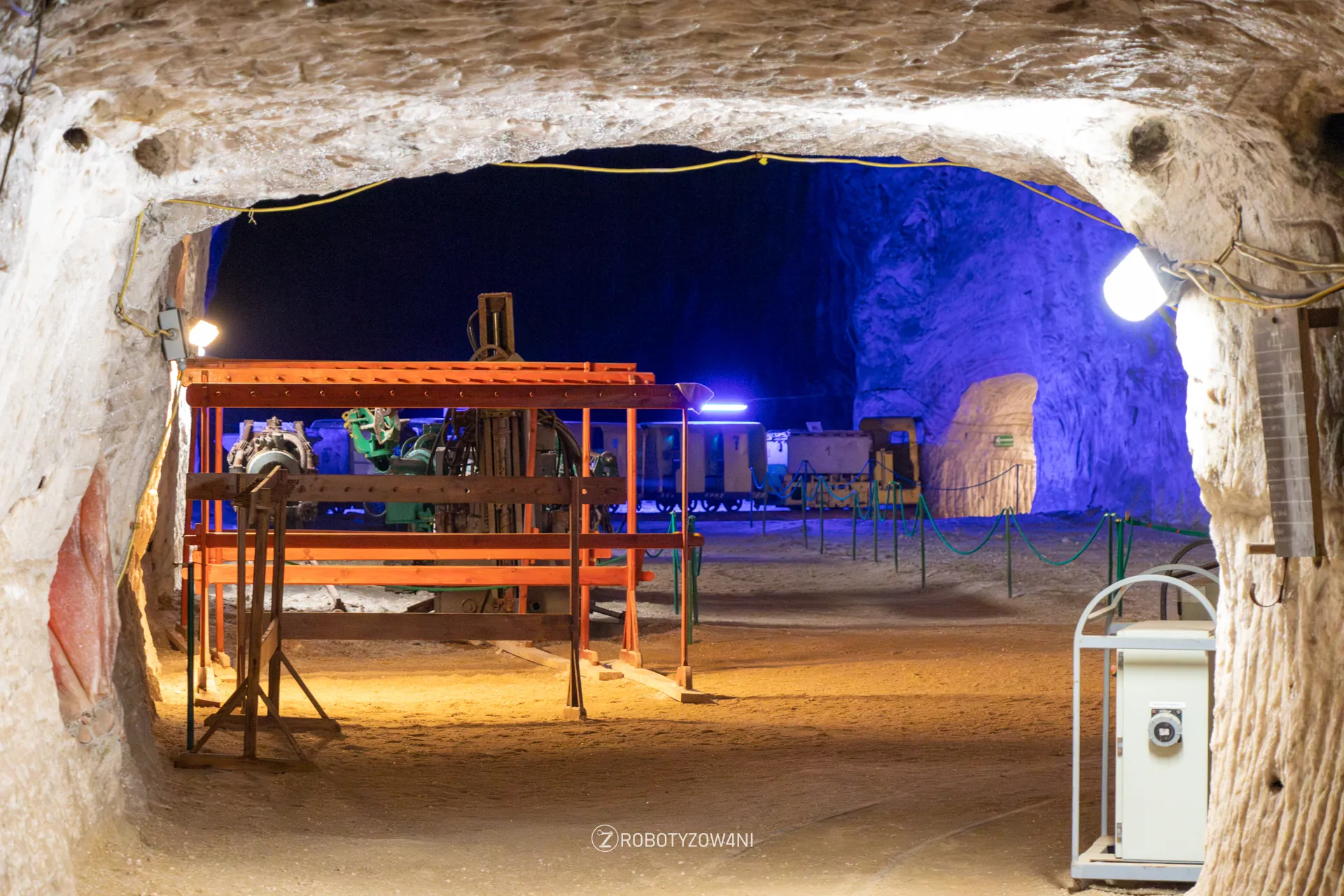
On Friday 11 December 2026 we return to Kłodawa. This time we go beyond the tourist route: together with the mine’s staff we will descend to the 810 m level, where rock salt is being mined during the shift. The group numbers 16 people, a figure set by the seats in two underground personnel carriers.
Key facts
- Date: Friday 11 December 2026, from 7:00 a.m.
- Place: Kopalnia Soli „Kłodawa” S.A., Kłodawa (Greater Poland).
- Programme: level 600 m (tourist route), level 810 m (active mining), surface plant.
- Group: 16 people including organisers, two SWT TEAM 10 vehicles with 8 seats each.
- Mining method: room-and-pillar, drill-and-blast, central blasting after 1 p.m.
A salt dome 26 kilometres long
Beneath Kłodawa lies a salt dome about 26 km long, the largest in the Polish Lowlands. Gravity surveys detected it in 1937–1939, construction of the mine was approved in 1949 and production began in 1956. For the first ten years horses hauled the broken salt underground; in 1966 they were replaced by electric haulage. Today Kopalnia Soli „Kłodawa” S.A. is the largest working rock salt mine in Poland, with a mining concession valid until 2052.
Mining has moved steadily deeper into the deposit: from the 450 and 600 m levels down to 750 m. In recent years the mine has opened up further levels at 780 and 810 m. The deepest of them is where we are going. More on the history of the mine can be found in the Kłodawa Salt Mine entry of the Zrobotyzowani Lexicon.
How salt is mined at Kłodawa
Kłodawa uses room-and-pillar mining. Large chambers are driven into the deposit, while pillars and ledges of salt are left between them to carry the load of the overlying rock. The salt is won with explosives. At the chamber face, drill rigs bore blast holes, which are then charged with explosives, while loaders clear the broken salt from the previous round.
Blasting takes place once a day, simultaneously for the whole level (so-called central blasting), when nobody remains underground. Our time on the 810 m level will therefore end before the blast, which takes place after 1 p.m., and the day starts early: the descent in the shaft cage is scheduled for 7:30 a.m.
Three levels in one day
The day is planned to follow the whole journey of the salt, from the working face to the bag.
- Level 600 m. The Kłodawa Underground Tourist Route: worked-out chambers, roadways and the salt chapel with a figure of St Kinga, patron saint of salt miners. We walk it before the first tourists arrive, with time for photography.
- Level 810 m. Chambers where mining is in progress: drilling of blast holes, loaders at work and preparation for blasting. About four hours with guides from the mine.
- Surface. The processing plant, packing hall and dispatch, where the salt hoisted up the shaft is crushed, screened and packed.
Times and the order of the programme depend on mine operations and the decisions of the mine supervisors. In a working mine, production and safety always come first.
Pink salt: the raw material, not a filter
Rock salt is rarely snow-white. The walls of the Kłodawa workings show shades of grey, orange and pink, which come from mineral admixtures locked in the deposit. The mine describes itself as the only producer of natural pink salt in Europe. The title of our visit, “Level 810: Kłodawa in shades of pink”, refers to the colour of the salt itself, not to any treatment of the photographs.
SWT TEAM 10: a Land Rover underground
Distances on the 810 m level are measured in kilometres, so we will travel the roadways and ramps in SWT TEAM 10 self-propelled personnel carriers built on the Land Rover Defender chassis. From the civilian vehicle they keep the 4×4 drive and the driver’s cab; the rear has been turned into an open load bed with benches along the sides, protected by steel roll bars. The number in the name is the number of seats.
Eight people sit in the back, sideways, knee to knee; the driver and a guide from the mine ride in front. For our visit the mine takes two of these vehicles out of daily crew transport. Hence the limit of 16 people, organisers included.
The underground railway: a closed chapter, the track remains
For decades salt and miners at Kłodawa were carried by an underground railway with electric locomotives. The mine has since switched to rubber-tyred transport, but track remains in many workings. What we will see of the former railway will become clear on site; we do not take a ride for granted.
Rules underground
A descent into a working mine involves formalities unknown to visitors on a tourist route. The mine receives a list of participants by name, and permission to take cameras underground is granted by the mine operations manager on the basis of the declared camera and lens models.
- Throughout the time underground every participant wears a helmet, a battery cap lamp and a self-rescuer, about 3 kg of equipment in total.
- When the guide says so, we stop taking photographs; there are a few places on the route where photography is not allowed.
- We do not publish photographs of anyone without a helmet, lamp or self-rescuer.
- The workings are above 20°C with very low humidity, and salt dust settles on equipment.
Frequently asked questions
When do Zrobotyzowani descend into the Kłodawa Salt Mine?
On Friday 11 December 2026. The day starts at 7:00 a.m. and the descent in the shaft cage is scheduled for 7:30. The group numbers 16 people including organisers.
How does the 810 m level differ from the tourist route?
The tourist route is on the 600 m level and leads through chambers worked out long ago. On the 810 m level mining is in progress: drilling of blast holes, loaders at work and preparation for blasting.
Why is Kłodawa salt pink?
The colour comes from mineral admixtures locked in the deposit. The Kłodawa Salt Mine describes itself as the only producer of natural pink salt in Europe.
What vehicles are used underground at Kłodawa?
SWT TEAM 10 self-propelled personnel carriers built on the Land Rover Defender chassis. Eight people sit in the open rear, sideways, knee to knee.
Does the Kłodawa Salt Mine still run an underground railway?
The mine has switched from the underground railway to rubber-tyred transport. Track remains in many workings.
Can you take photographs in a working salt mine?
Yes, with the permission of the mine operations manager, granted on the basis of a named list and declared camera models. Photography stops whenever the guide says so.
Sources: Kopalnia Soli „Kłodawa” S.A. (sol-klodawa.com.pl, checked 16 Nov 2026); arrangements with the mine of 12 Oct 2026; AGH University publications on the development of the 780 and 810 m levels; Zrobotyzowani Lexicon.
This article is for information only and does not constitute an offer within the meaning of Article 66 § 1 of the Polish Civil Code.