Zrobotyzowani Educational Path in cooperation with PAK Górnictwo, PAK KWB Konin SA – Railway Traffic Control at KWB Konin – why trains run safely
July 5, 2025 – this day will long remain in the memory of everyone who decided to set out with Zrobotyzowani on an expedition to the heart of the industrial railway of KWB Konin. From the very morning, you could feel the excitement, but also… the heat pouring from the sky! The temperature didn’t let up for a moment, so every sip of water and bit of shade was worth its weight in gold.
The gathering at the water tower by the station in Konin began punctually at 9:55 AM. Participants, equipped with necessary documents and appropriate attire, collected their tickets, while organizers efficiently verified discount eligibility and discussed the program and safety rules. Everyone received reflective vests and tour guides – portable receivers that proved invaluable in the cramped rooms of the signal box and relay room, where the hum of fans and the clicking of relays could drown out even the most interesting story.
After a brief introduction, we boarded Mr. Arkadiusz’s historic bus, the TAM190 – this classic of motorization, with its characteristic V6 engine rumble and the scent of bygone years, transported us to the atmosphere of past decades. Through the windows, the green landscapes of Greater Poland flickered by, and the air was filled with an atmosphere of adventure and anticipation for what we were about to see.
Would you like to come face to face with a gigantic relay system and discover the secrets of safe railway traffic?
Join our next events, and you will discover this and other secrets of the Mining Railways!


Mining Railway Facilities in Kazimierz Biskupi and the KWg signal box
In the huge locomotive depot hall, we could admire the powerful “Crocodiles” up close – LEW EL2 electric locomotives, which have been the heart of the mine’s routes for decades. We looked into the drivers’ cabins, touched the side pantographs, and the guides – Mr. Andrzej Rudziński and Mr. Mirosław Krzymiński – talked about daily inspections, repairs, and the challenges of maintaining these machines. The next point was the tiny Workshop signal box Wa, where tour participants, under the supervision of the hosts, could test the operation of manually operated hook-type track locks.


In the signal box, a 10-minute walk away, a classic mosaic tile panel awaited us, and right next to it – the relay room, where hundreds of relays quietly clicked, carrying out the dispatcher’s commands. Thanks to the tour guides, everyone could hear the guides’ stories, even standing in the farthest part of the railway landscape. There, we also learned about the most common type of track lock, the slide lock. In the relay rooms and other railway automation rooms, we were accompanied by another guide – Mr. Paweł Napieralski, who patiently answered even the most detailed questions from the participants.


Estakada Wschód and Przesmyk-Gaj
The next stages of the tour were the Estakada Wschód and Przesmyk-Gaj signal boxes – in each one, we also entered the relay room, admiring the “brain” of the safety system up close. The traffic dispatchers and our guides explained how routes are set, how line blockades work, and how every signal is checked by the system. Upon entering the signal box, we immediately felt the atmosphere of old times – before us lay a classic mosaic tile panel with a track diagram, dozens of colorful lights, switches, and buttons. It is on such a panel that the traffic dispatcher sets the route for a train: setting points, closing the appropriate circuits, and giving a proceed signal on the semaphore. There was also an opportunity to ask our specialists questions – they were happy to share their knowledge about other interesting devices, such as light signals, warning discs, or the radio communication system.


Drzewce Rest Stop
After lunch and a short rest in Licheń, we headed to the last point of the program – the Drzewce signal box. This place particularly appealed to history fans – they could familiarize themselves with old documents and dispatchers’ logs from years ago, when Drzewce still dispatched coal trains daily. In this signal box, as in the previous ones, we entered the relay room, where time seemed to stand still. For many participants, it was a living history lesson – they could touch the past, see what the dispatchers’ work was like in the days when the mining railway was bustling with life.
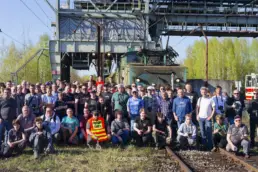
There had to be a moment for a souvenir photo – we took it in the place where a year earlier, during the Crocodiles Golden Hour event, there was still a lignite loading facility. Today, little remains of it – a symbolic sign of how quickly the industrial landscape can change. This photo will be not only a memento for us but also a reminder that industrial history is being written before our very eyes.


Contests for participants and industrial shots
At the end of the event, a surprise awaited the participants – a knowledge contest with prizes! Questions were asked by both the organizers and our guide, Mr. Andrzej Rudziński. The participants showed not only technical knowledge but also quick reflexes – emotions ran high, and the prizes went to the most alert and attentive. It was not only fun but also an opportunity to consolidate the acquired knowledge and integrate the group.
The entire trip, Railway Traffic Control at KWB Konin – why trains run safely, turned out to be a true adventure in every sense of the word. Participants unanimously agreed that they had never experienced such an engaging tour of Railway Traffic Control Systems. The combination of the guide’s expert knowledge with the opportunity to experience everything live made us feel the spirit of the railway and understand the complexity of the systems responsible for safe rail traffic in practice.
A great asset of the event was also the opportunity to capture these moments in photos – both from the ground and from the air. The organizers made sure that the entire trip was documented photographically. Organizers and participants took dozens of photos, hunting for the perfect shots of the group and elements of the RTC or the legendary Crocodiles, the EL2 locomotives. Additionally, the Zrobotyzowani team took drone shots, allowing us to admire the Mining Railway network from a completely different perspective – from a bird’s-eye view, you can see the extensive threads of railway tracks and open-pit mines that create a unique industrial landscape of Greater Poland. These industrial photos from the ground and air are not only pleasing to the eye but also a wonderful memento documenting our experiences.
Keywords: industrial tourism, mine tour, Konin Lignite Mine, KWB Konin, ZE PAK, technology, one-day guided tour, event report, Zrobotyzowani, industrial photos, industry from the inside.


Sounds like a great day? See where else we are going in the near future:
After nearly 7 hours of touring full of impressions, it was time to conclude our event: Railway Traffic Control at KWB Konin – why trains run safely. After returning the safety equipment and saying goodbye to the guide, the participants shared their impressions for a long time in the historic TAM190 bus on the way to the Water Tower in Konin. Everyone agreed that such a trip is a great example of how industrial tourism can be both fascinating and educational. How an industrial tour, a one-day trip, can be a great company integration event. Touring the Mining Railways with Zrobotyzowani turned out to be a bullseye – it provided both technical curiosities and deep emotions. For our participants, it was a one-of-a-kind trip, integrating enthusiasts and leaving indelible memories. We hope to repeat such a guided tour again, discovering more secrets of Poland’s industrial corners.
Finally, we would like to thank all participants for their commitment and our partners from the Konin Lignite Mine for making this extraordinary visit possible. We encourage you to view the full photo gallery from the event – let them speak to you just as the scenes from the educational path are still vividly painted in our minds!
Special thanks go to the companies PAK KWB Konin S.A. and PAK Górnictwo sp. z o.o. for the unique opportunity to get acquainted with the world of railway automation of the Mining Railways.
We could not have organized this event without the support of: Mr. Andrzej Rudziński, Mr. Paweł Napieralski, and Mr. Mirosław Krzymiński. Their vast knowledge, patience, anecdotes, and ability to convey even the most complex technical issues in an accessible way were the greatest asset of the tour.
We also thank everyone who helped in the preparation and documentation of the event – from the technical support, through the photographers, to the people who took care of our safety and comfort.
Photos taken by: Paulina Kozłowska, Jakub Kisieliński, Adrian Kulik, Karol Lubaczewski
Report prepared by Paulina Kozłowska.